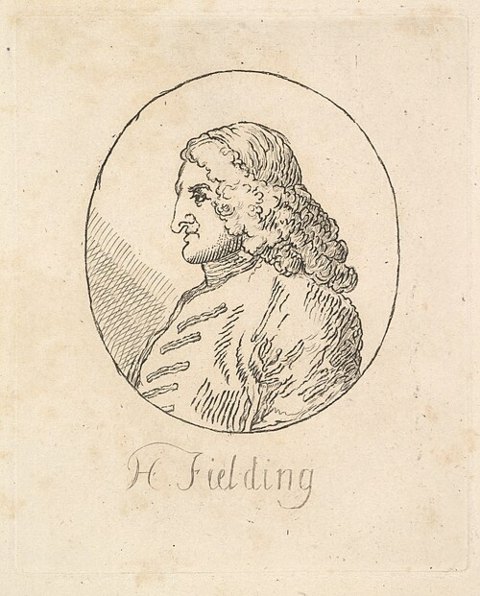
Henry Fielding (22 April 1707 – 8 October 1754) was an English writer and judge known for the use of humour and satire in his works. His famous novels include Shamela (1741), Joseph Andrews (1742), The History of Tom Jones, a Foundling (1749) and Amelia (1751). Along with Samuel Richardson, Fielding is seen as the founder of the traditional English novel. As well as being a novelist, Fielding was also a playwright, known for his satirical comedies The Author's Farce (1730), Tom Thumb (1730), The Letter Writers (1731) and The Tragedy of Tragedies (1731). He also played an important role in the history of law enforcement in the United Kingdom, using his authority as a magistrate to found the Bow Street Runners, London's first professional police force.
Early life
Henry Fielding was born on 22 April 1707 at Sharpham Park, the seat of his mother's family in Sharpham, Somerset. He was the son of Lt.-Gen. Edmund Fielding and Sarah Gould, daughter of Sir Henry Gould. A scion of the Earl of Denbigh, his father was nephew of William Fielding, 3rd Earl of Denbigh.
Educated at Eton College, Fielding began a lifelong friendship with William Pitt the Elder. His mother died when he was 11. A suit for custody was brought by his grandmother against his charming but irresponsible father, Lt Gen. Edmund Fielding. The settlement placed Henry in his grandmother's care, but he continued to see his father in London.
In 1725, Henry tried to abduct his cousin Sarah Andrews, with whom he was infatuated, while she was on her way to church. He fled to avoid prosecution.