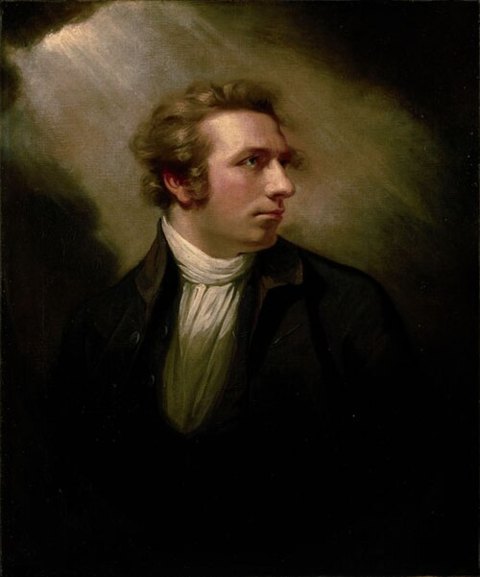
Henry Fuseli (FEW-zə-lee, few-ZEL-ee; German: Johann Heinrich Füssli [ˈjoːhan ˈhaɪ̯nʁɪç ˈfyːsli]; 7 February 1741 – 17 April 1825) was a Swiss painter, draughtsman, and writer on art who spent much of his career in Britain.
Many of his successful works depict supernatural experiences, such as The Nightmare. He produced painted works for John Boydell's Shakespeare Gallery and for his own "Milton Gallery". He held the posts of Professor of Painting and Keeper at the Royal Academy. His style had a considerable influence on many younger British artists, including William Blake (1757–1827).
Biography
Fuseli was born on 7 February 1741 in Zürich, the second of 18 children. Among his brothers and sisters were Johann Kaspar and Anna. His father was Johann Caspar Füssli, a painter of portraits and landscapes, and author of Lives of the Helvetic Painters. He intended Henry for the church, and sent him to the Caroline college of Zürich, where he received a classical education. One of his schoolmates there was Johann Kaspar Lavater, with whom he became close friends.
After taking orders in 1761, Fuseli was forced to leave the country as a result of having helped Lavater to expose an unjust magistrate, whose powerful family sought revenge. He travelled through Germany, and then, in 1765, visited England, where he supported himself for some time by miscellaneous writing. Eventually, he became acquainted with Sir Joshua Reynolds, to whom he showed his drawings. Following Reynolds' advice, he decided to devote himself entirely to art. In 1770, he made an art pilgrimage to Italy, where he remained until 1778, changing his name from Füssli to the more Italian-sounding Fuseli. In Rome, he moved in the same circles as the Scottish artist Alexander Runciman and the Swedish sculptor Tobias Sergel.