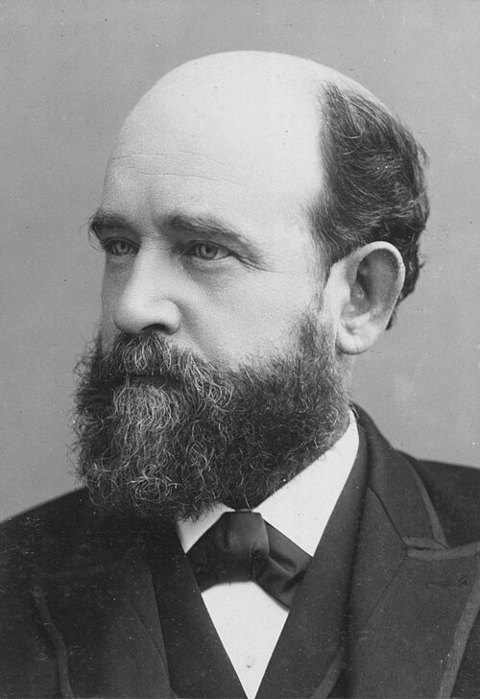
Henry George (September 2, 1839 – October 29, 1897) was an American political economist, social philosopher and journalist. His writing was popular in 19th-century America and sparked several reform movements of the Progressive Era. He inspired the economic philosophy known as Georgism, the belief that people should own the value they produce themselves, but that the economic value of land (including natural resources) should belong equally to all members of society. George famously argued that a single tax on land values would create a more productive and just society.
His most famous work, Progress and Poverty (1879), sold millions of copies worldwide. The treatise investigated the paradox of increasing inequality and poverty amid economic and technological progress, the business cycle with its cyclic nature of industrialized economies, and the use of rent capture such as land value taxation and other anti-monopoly reforms as a remedy for these and other social problems. Other works by George defended free trade, the secret ballot, free (at marginal cost) public utilities/transportation provided by the capture of their resulting land rent uplift, Pigouvian taxation, and public ownership of other natural monopolies.
George was a journalist for many years, and the popularity of his writing and speeches brought him to run for election as Mayor of New York City in 1886 as the United Labor Party nominee and in 1897 as the Jefferson Democracy nominee, where he received 31 percent and 4 percent of the vote respectively and finished ahead of former New York State Assembly minority leader and future President Of The United States Theodore Roosevelt in the first race. After his death during the second campaign, his ideas were carried forward by organizations and political leaders through the United States and other Anglophone countries. The mid-20th century labor economist and journalist George Soule wrote that George was by far "the most famous American economic writer" and "author of a book which probably had a larger world-wide circulation than any other work on economics ever written."