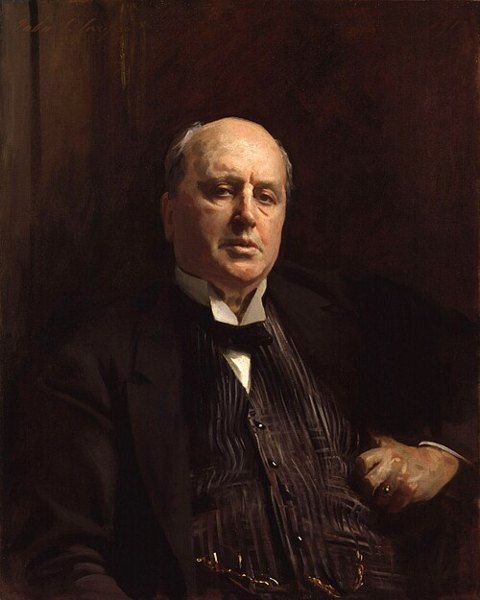
Henry James ((1843-04-15)15 April 1843 – (1916-02-28)28 February 1916) was an American-British author. He is regarded as a key transitional figure between literary realism and literary modernism, and is considered by many to be among the greatest novelists in the English language. He was the son of theologian Henry James Sr. and the brother of philosopher and psychologist William James and diarist Alice James.
James's novels deal with the social and marital interplay between émigré Americans, the English, and continental Europeans, such as The Portrait of a Lady (1881). His later works, such as The Wings of the Dove (1902), The Ambassadors (1903), and The Golden Bowl (1904) were increasingly experimental. In describing the internal states of mind and social dynamics of his characters, James often wrote in a style in which ambiguous or contradictory motives and impressions were overlaid or juxtaposed in the discussion of a character's psyche. For their unique ambiguity, as well as for other aspects of their composition, his late works have been described as Impressionist.
His novella The Turn of the Screw (1898) has garnered a reputation as the most analysed and ambiguous ghost story in the English language and remains his most widely adapted work in other media. He wrote other highly regarded ghost stories, such as "The Jolly Corner" (1908).
James published articles and books of criticism, travel, biography, autobiography, and plays. Born in the United States, he spent much of his life abroad. James largely relocated to Europe in his thirties, and eventually settled in England, becoming a British citizen in 1915, a year before his death. James was nominated for the Nobel Prize in Literature in 1911, 1912, and 1916. Jorge Luis Borges said, "I have visited some literatures of East and West; I have compiled an encyclopedic compendium of fantastic literature; I have translated Kafka, Melville, and Bloy; I know of no stranger work than that of Henry James."