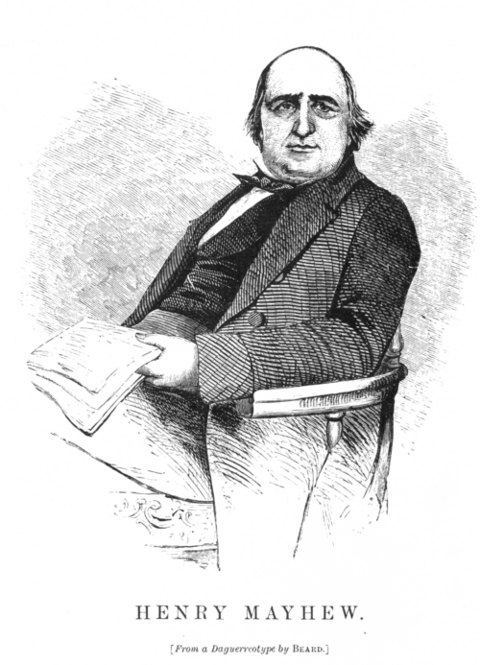
Henry Mayhew (25 November 1812 – 25 July 1887) was an English journalist, playwright, and advocate of reform. He was one of the co-founders of the satirical magazine Punch in 1841, and was the magazine's joint editor, with Mark Lemon, in its early days. He is also known for his work as a social researcher, publishing an extensive series of newspaper articles in the Morning Chronicle that was later compiled into the three-volume book London Labour and the London Poor (1851), a groundbreaking and influential survey of the city's poor.
Early life
He was born in London, the thirteenth of 17 children to Joshua Mayhew. He was educated at Westminster School before running away from his studies to the sea. He then served with the East India Company as a midshipman on a ship bound for Calcutta. He returned after several years, in 1829, becoming a trainee lawyer in Wales. He left this career to become a freelance journalist. He contributed to The Thief, a readers' digest, followed quickly by founding a weekly comic journal – Figaro in London (1831–1839). Mayhew reputedly fled his creditors and holed up at the Erwood Inn, a small public house in the village of Erwood, south of Builth Wells in Wales.
Paris and writing
In 1835, Mayhew found himself in a state of debt and, along with a fellow writer, escaped to Paris to avoid his creditors. He spent his time writing and in the company of other writers including William Thackeray and Douglas Jerrold. Mayhew spent over 10 years in Paris, returning to England in the 1850s, whereupon he was involved in several literary adventures, mostly the writing of plays. Two of his plays – The Wandering Minstrel (1834) and But, However (1842) – were successful, whilst his early work Figaro in London was less successful.