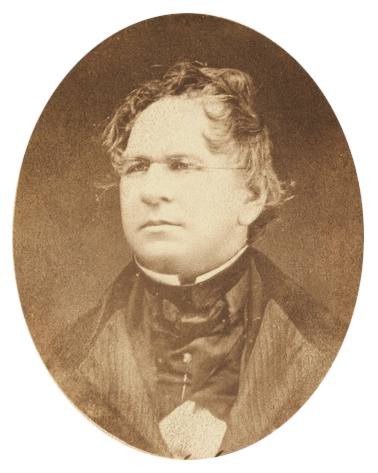
Henry Rowe Schoolcraft (March 28, 1793 – December 10, 1864) was an American geographer, geologist, and ethnologist, noted for his early studies of Native American cultures, as well as for his 1832 expedition to the source of the Mississippi River. He is also noted for his major six-volume study of Native Americans commissioned by Congress and published in the 1850s.
He served as United States Indian agent in Michigan for a period beginning in 1822. During this period, he named several newly organized counties, often creating neologisms that he claimed were derived from indigenous languages.
There he married Jane Johnston, daughter of a prominent Scotch-Irish fur trader and an Ojibwe mother, who was the high-ranking daughter of Waubojeeg, a war chief. Jane lived with her family in Sault Ste. Marie, Michigan. She was bilingual and educated, having grown up in a literate household. Jane taught Schoolcraft the Ojibwe language and much about her maternal culture. They had several children together, only two of whom survived past childhood. She is now recognized for her poetry and other writings as the first Native American literary writer in the United States.
Schoolcraft continued to study Native American tribes and publish works about them. In 1833, he was elected as a member of the American Philosophical Society.
By 1846, Jane had died. That year, Schoolcraft was commissioned by Congress for a major study, known as Indian Tribes of the United States. It was published in six volumes from 1851 to 1857, and illustrated by Seth Eastman, a career Army officer with extensive experience as an artist of indigenous peoples.
Schoolcraft remarried in 1847, to Mary Howard, from a slaveholding family in South Carolina. In 1860, Howard published the bestselling novel The Black Gauntlet. It was part of the Anti-Tom literature that was written in Southern response to the bestselling Uncle Tom's Cabin by Northern abolitionist Harriet Beecher Stowe.