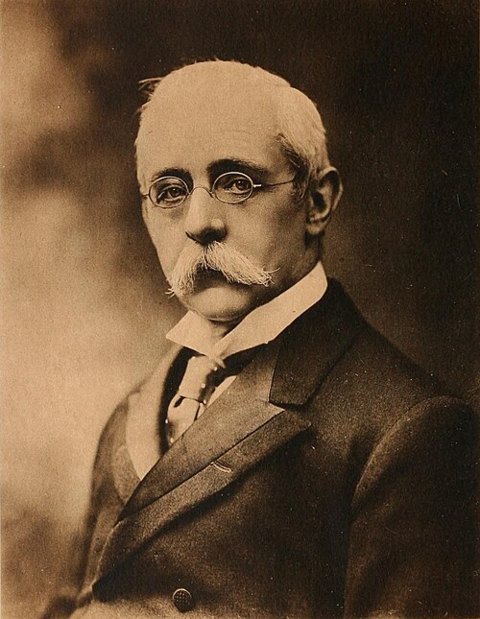
Herbert Allen Giles (Chinese: 翟理斯, romanized: Zhái Lǐsī; 8 December 1845 – 13 February 1935) was a British diplomat and sinologist who held the Professorship of Chinese at the University of Cambridge for 35 years. Giles was educated at Charterhouse School before becoming a British diplomat in China. He modified a Mandarin Chinese romanization system established by Thomas Wade, resulting in the widely known Wade–Giles Chinese romanization system. Among his many works were translations of the Analects of Confucius, the Lao Tzu (Tao Te Ching), the Chuang Tzu, and, in 1892, the widely published A Chinese–English Dictionary.
Biography
Herbert Allen Giles was the fourth son of John Allen Giles (1808–1884), an Anglican clergyman. After studying at Charterhouse, Herbert became a British diplomat to Qing China, serving from 1867 to 1892. He also spent several years (1885–1888) at Fort Santo Domingo in Tamsui, northern Taiwan. Giles' great-grandson, Giles Pickford, stated in an address at the opening of the Fort Santo Domingo Museum – 8 November 2005, that his great-grandfather, Herbert A Giles, was Her Britannic Majesty's Consul in Tamsui, Fort Santo Domingo from 1885 until 1891. Prior to that time, in 1869, Giles was based at Kaohsiung. He married Catherine Maria (Kate) Fenn in 1870 and was the father of Bertram, Valentine, Lancelot, Edith, Mable, and Lionel Giles.
In 1897 Herbert Giles became only the second professor of Chinese language appointed at the University of Cambridge, succeeding Thomas Wade. At the time of his appointment, there were no other sinologists at Cambridge. Giles was therefore free to spend most of his time among the ancient Chinese texts earlier donated by Wade, publishing what he chose to translate from his eclectic reading in Chinese literature. Giles published over sixty books, lectures, pamphlets, journal articles, book reviews, and newspaper articles. During his long life he completed a comprehensive Chinese-English Dictionary which took over fifteen years to compile and became a standard reference for many years. Giles also published the first history of Chinese literature and art, which also became a reference work. Some of his translations have stood the test of time and are still among the best available. Giles was not afraid to be controversial and outspoken on numerous topics. To quote his great-grandson, "Most of his enemies were people whose work he had criticized. Such people included E H Parker, a sinologist at Manchester University; Sir Walter Hillier a sinologist from London; and Sir Thomas Wade, Minister to China (1870-76 and 1880-82) and therefore Giles's superior in the Consular Service. Wade was later Professor of Chinese at the University of Cambridge (1888-95). Giles was to succeed him in this position in 1897." Giles was also outspoken on the work of Christian Missionaries and British traders because of the overcrowding of Chinese emigrants on British ships. Yet as Charles Aylmer wrote, in his Memoirs of H. A. Giles, "Notwithstanding his reputation for abrasiveness, he would speak to anyone in the street from the Vice-Chancellor to a crossing-sweeper and was remembered by acquaintances as a man of great personal charm. " Giles wrote some of his works in conjunction with his son, Dr. Lionel Giles, also an expert on China, who was employed as the Deputy Keeper of Oriental Printed Books and Manuscripts at the British Museum.