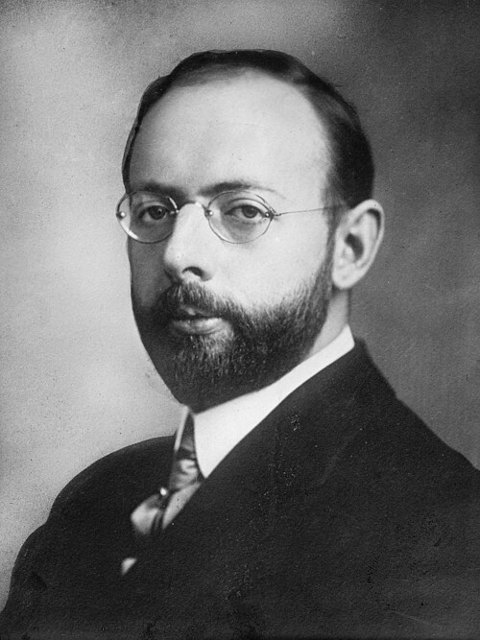
Herbert Eugene Ives (July 31, 1882 – November 13, 1953) was a scientist and engineer who headed the development of facsimile and television systems at AT&T in the first half of the twentieth century. He is best known for the 1938 Ives–Stilwell experiment, which provided direct confirmation of special relativity's time dilation, although Ives himself did not accept special relativity, and argued instead for an alternative interpretation of the experimental results. Ives has been described as "the most authoritative opponent of relativity in United States between the late 1930s and the early 1950s."
Biography
Ives was born on July 31, 1882, in Philadelphia, Pennsylvania, to Frederic Eugene Ives and Mary Olmstead. He studied at the University of Pennsylvania and the Johns Hopkins University, where he graduated in 1908. He married Mabel Lorenz in the same year and they had three children.
He wrote a 1920 book on aerial photography while an Army reserve officer in the aviation section. He was president of the Optical Society of America (now Optica) from 1924 to 1925. At the Bell Labs he became its Director of Electro-Optical Research.
Like his father Frederic E. Ives, Herbert was an expert on color photography. In 1924, he transmitted and reconstructed the first color fax, a natural-color photograph of silent film star Rudolph Valentino in period costume, using red, green and blue color separations he photographed on the set of Valentino's film Monsieur Beaucaire.
On April 7, 1927, Ives demonstrated 185-line long-distance television, transmitting live video images of then-Secretary of Commerce Herbert Hoover via AT&T's experimental station 3XN in Whippany, New Jersey, allowing media reporters to both see and communicate with Hoover. By 1930, his two-way television-telephone system (called an ikonophone – Greek: 'image-sound') was in regular experimental use. Bell Labs' large New York City research facility devoted years of research and development through the 1930s, led by Dr. Ives with his team of more than 200 scientists, engineers and technicians. Bell Labs intended to develop videotelephony and television for both telecommunications and broadcast entertainment purposes. Ongoing research into combined audio and video telephones was extended by Bell Labs far past Ives' tenure at a cost of over US$500 million, eventually resulting in the deployment of AT&T's futuristic Picturephone.