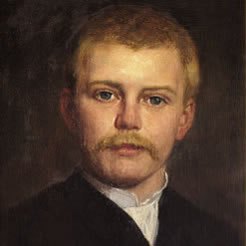
Herman Gorter (Dutch: [ˈɣɔrtər]; 26 November 1864 – 15 September 1927) was a Dutch poet, classical scholar, and communist theorist. A leading member of the Tachtigers, a highly influential literary movement in the Netherlands, he was one of the most acclaimed poets of his generation for his 1889 lyrical epic Mei. After 1897, he became a committed Marxist and a prominent theoretician of the international communist left.
Gorter joined the Social Democratic Workers' Party (SDAP) in 1897, becoming a leading voice of its left-wing Marxist opposition. In 1909, he was part of the Tribunist schism that formed the Social Democratic Party (SDP). Following the outbreak of the First World War, Gorter became a staunch opponent of the war and a prominent internationalist, aligning with the Zimmerwald Left. He hailed the Russian Revolution of 1917 as the beginning of the world revolution and supported Vladimir Lenin and the Bolsheviks.
After 1918, Gorter became a key figure in the German communist left, particularly within the Communist Workers' Party of Germany (KAPD). In 1920, he authored the Open Letter to Comrade Lenin, a seminal critique of the Communist International's turn toward parliamentary and trade union tactics, which became a foundational text of left communism. He was a primary force behind the creation of the Communist Workers' International (KAI) in 1921. He spent his final years working to regroup the divided left-communist movement until his death in 1927.