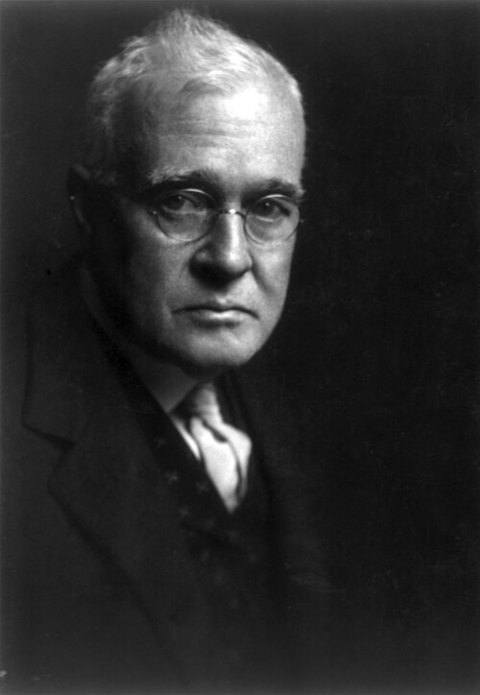
Horace Fletcher (August 10, 1849 – January 13, 1919) was an American food faddist who earned the nickname "The Great Masticator" for his argument that food should be chewed thoroughly until liquefied before swallowing: "Nature will castigate those who don't masticate." He made elaborate justifications for this claim.
Biography
Fletcher was born August 10, 1849, at Haverhill Street in Lawrence, Massachusetts. He left home at sixteen and throughout his career worked as an artist, importer, manager of the New Orleans Opera House and writer. Fletcher suffered from dyspepsia and obesity in his later years, so he devised a system of chewing food to maximize digestion. His mastication system became known as "Fletcherism". He was a member of The Boston Club of New Orleans and founding member of The Bohemian Club of San Francisco.
Fletcher and his followers recited and followed his instructions religiously, even claiming that liquids, too, had to be chewed in order to be properly mixed with saliva. Fletcher argued that his mastication method will increase the amount of strength a person could have while actually decreasing the amount of food that he consumed. Fletcher promised that "Fletcherizing", as it became known, would turn "a pitiable glutton into an intelligent epicurean".
Fletcher also advised against eating before being "good and hungry", or while angry or sad. Fletcher would claim that knowing exactly what was in the food one consumed was important. In The New Glutton or Epicure, published in 1906, he stated that different foods have different waste materials, so knowing what type of waste one was going to have in one’s body was valuable knowledge, thus critical to one’s overall well being. He promoted his theories for decades on lecture circuits, and became a millionaire. Upton Sinclair, Henry James and John D. Rockefeller were among those who gave his ideas a try. James and Mark Twain were visitors to his residence in the Palazzo Saibante in Venice, where he lived with his wife, Grace Fletcher, an amateur painter, who studied in Paris in the 1870s and was influenced by the Impressionists, and her daughter, Ivy. Ivy, later to become a journalist at the Daily Express in the 1930s, was often a guinea pig for Horace's experiments, which she described in her unpublished memoirs Remember Me.