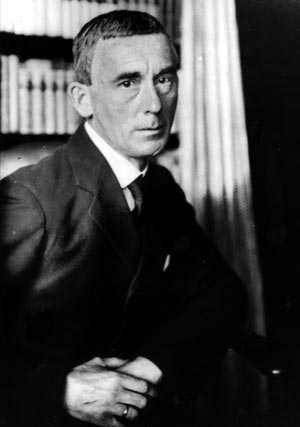
Author
Hugo Ball
German author, poet and one of the leading Dada artists (1886–1927)
- Born
- February 22, 1886, Pirmasens
- Died
- September 14, 1927, Sant'Abbondio
- Nationality
- Germany
- Occupation
- Translator, poet, theatre director, writer and philosopher
- Movement
- Dada
- Notable works
- Karawane · Hermann Hesse · Flight out of time · Byzantinisches Christentum: Drei Heiligenleben
Life and work
Hugo Ball (German: [bal]; 22 February 1886 – 14 September 1927) was a German author, poet, and essentially the founder of the Dada movement in European art in Zürich in 1916. Among other accomplishments, he was a pioneer in the development of sound poetry. His best known works include the "Dada Manifesto", the Dadaist nonsense poem "Karawane", the poetry collection 7 schizophrene Sonette, the edited diary Flight out of Time, the Christian anarchist polemic book Critique of the German Intelligentsia and the novels Flametti, or The Dandyism of the Poor and Tenderenda the Fantast.
Life and work
Hugo Ball was born in Pirmasens, Germany, and was raised in a middle-class Catholic family. He studied sociology and philosophy at the Ludwig-Maximilians-Universität München and Heidelberg University (1906–1907). In 1910, he moved to Berlin in order to become an actor and collaborated with Max Reinhardt. At the beginning of World War I, he tried joining the army as a volunteer, but was denied enlistment for medical reasons. After witnessing the invasion of Belgium, he was disillusioned, saying: "The war is founded on a glaring mistake – men have been confused with machines." Considered a traitor in his country, he crossed the frontier with the cabaret performer and poet Emmy Hennings, whom he would marry in 1920, and settled in Zürich, Switzerland. There, Ball continued his interest in anarchism and in Mikhail Bakunin in particular; he also worked on a book of translations of works by Bakunin, which never got published. Although interested in anarchist philosophy, he nonetheless rejected it for its militant aspects, and viewed it as only a means to his personal goal of socio-political enlightenment.
Text: “Hugo Ball”, from Wikipedia, the free encyclopedia, under the license CC BY-SA 4.0. Dates and facts: Wikidata.
Collection
Books by Hugo Ball
1 book