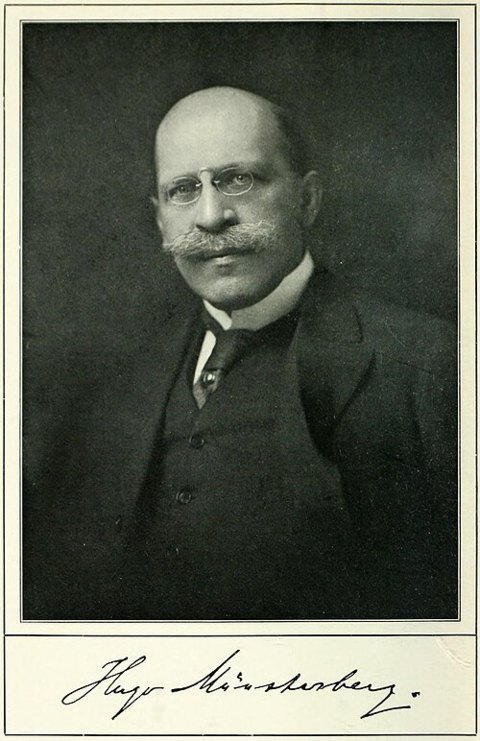
Hugo Münsterberg (German: [ˈmʏnstɐbɛʁk]; June 1, 1863 – December 16, 1916) was a German-American psychologist. He was one of the pioneers in applied psychology, extending his research and theories to industrial/organizational (I/O), legal, medical, clinical, educational and business settings. Münsterberg experienced immense turmoil with the outbreak of the First World War. Torn between his loyalty to the United States and his homeland, he often defended Germany's wartime actions, and was ostracized at Harvard.
Early life
Hugo Münsterberg was born into a merchant family in Danzig, Prussia (now Gdansk, Poland), then a port city in West Prussia. Münsterberg's family was Jewish, a heritage with which he felt no connection and would barely ever manifest publicly. His father Moritz (1825–1880), was a successful lumber merchant and his mother, Minna Anna Bernhardi (1838–1875), a recognized artist and musician, was Moritz's second wife. Moritz had two sons with his first wife, Otto (1854–1915) and Emil (1855–1915), and two with Anna, Hugo (1863–1916) and Oscar (1865–1920). The four sons remained close, and all of them became successful in their careers. A neo-Renaissance villa in Detmold, Germany, that Oscar lived in from 1886 to 1896 has recently been renovated and opened as a cultural center.
The family had a great love of the arts, and Münsterberg was encouraged to explore music, literature, and art. Both his mother and his father died before he was 20 years old. When Münsterberg was 12, his mother died, transforming him from a care-free child to a much more serious young man. In 1880, his father also died.