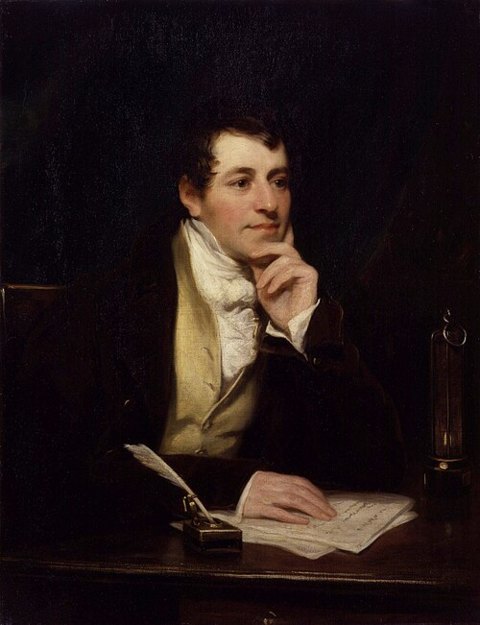
Sir Humphry Davy, 1st Baronet (17 December 1778 – 29 May 1829) was a British chemist and inventor who invented the Davy lamp and an early form of arc lamp. He is also remembered for isolating, by using electricity, several elements for the first time: potassium and sodium in 1807 and calcium, strontium, barium, magnesium, and boron the following year, and for discovering the elemental nature of chlorine and iodine. Davy also studied the forces involved in these separations, inventing the new field of electrochemistry. He is credited with discovering clathrate hydrates.
In 1799, he experimented with nitrous oxide and was astonished at how it made him laugh. He nicknamed it "laughing gas" and wrote about its potential as an anaesthetic to relieve pain during surgery. Davy was a baronet, President of the Royal Society (PRS), Member of the Royal Irish Academy (MRIA), a founder member and Fellow of the Geological Society of London, a member of the Royal Geological Society of Cornwall, and a member of the American Philosophical Society. Berzelius called Davy's 1806 Bakerian Lecture "On Some Chemical Agencies of Electricity" "one of the best memoirs which has ever enriched the theory of chemistry."