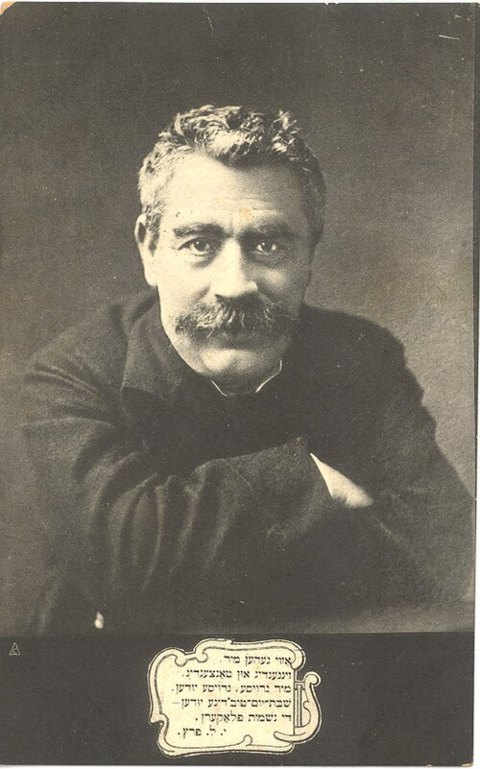
Isaac Leib Peretz (May 18, 1852 – April 3, 1915), also sometimes written Yitskhok Leybush Peretz (Polish: Icchok Lejbusz Perec; Yiddish: יצחק־לייבוש פרץ), was a Polish Jewish writer and playwright writing in Yiddish. Payson R. Stevens, Charles M. Levine, and Sol Steinmetz count him with Mendele Mokher Seforim and Sholem Aleichem as one of the three great classical Yiddish writers. Sol Liptzin wrote: "Yitzkhok Leibush Peretz was the great awakener of Yiddish-speaking Jewry and Sholom Aleichem its comforter... Peretz aroused in his readers the will for self-emancipation, the will for resistance against the many humiliations to which they were being subjected."
Peretz rejected cultural universalism, seeing the world as composed of different nations, each with its own character. In Liptzin's account, "[e]very people is seen by him to be a chosen people, chosen by its peculiar history, geography and ethnic composition"; he conceived of Jewish literature as "grounded in Jewish traditions and Jewish history", and as "the expression of Jewish ideals".
Peretz was part of the Haskalah movement. In the 1870s, as a young maskil, Peretz looked down upon Yiddish as “jargon,” a term of contempt employed by many Jewish intellectuals. After the pogroms of 1881, which set off the first great wave of migration to America, Peretz's feeling for Yiddish grew warmer and he began to connect to the East European Jewish intelligentsia's movement towards Yiddish, yet intent upon a rationalist modernizing of Jewish thought.
However, while many other Maskilim mocked or derided Hasidic Judaism, Peretz greatly respected the Hasidic Jews for their mode of being in the world; at the same time, his narratives made allowances for human frailty.
His short stories such as "If Not Higher", "The Treasure", and "Beside the Dying" emphasize "unsensational deeds of piety" over empty religiosity.
Peretz eventually became a leading founder in the Yiddishist movement. He is regarded as foundational to modern Yiddish fiction and one of the highly influential, central figures in the Yiddishist movement.