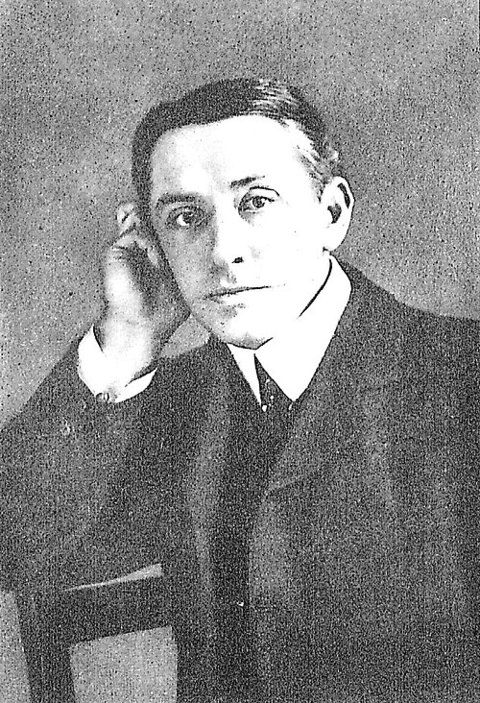
Joseph Smith Fletcher (7 February 1863 – 30 January 1935) was an English journalist and author. He wrote more than 230 books on a wide variety of subjects, both fiction and non-fiction, and was one of the most prolific English writers of detective fiction.
Early life and education
Fletcher was born in Halifax, West Yorkshire, the son of a clergyman. His father died when he was eight months old, and after which his grandmother raised him on a farm in Darrington, near Pontefract. He was educated at Silcoates School in Wakefield, and after some study of law, he became a journalist.
Writing career
At age 20, Fletcher began working in journalism, as a sub-editor in London. He subsequently returned to his native Yorkshire, where he worked first on the Leeds Mercury using the pseudonym A Son of the Soil, and then as a special correspondent for the Yorkshire Post covering Edward VII's coronation in 1902.
Fletcher's first books published were poetry. He then moved on to write numerous works of historical fiction and history, many dealing with Yorkshire, which led to his selection as a fellow of the Royal Historical Society.
Michael Sadleir stated that Fletcher's historical novel, When Charles I Was King (1892), was his best work. Fletcher wrote several novels of rural life in imitation of Richard Jefferies, beginning with The Wonderful Wapentake (1894).
In 1914, Fletcher wrote his first detective novel and went on to write over a hundred more, many featuring the private investigator Ronald Camberwell.
Fletcher published multiple crime fiction novels during the "Golden Age of Detective Fiction," namely his The Middle Temple Murder (1919) which served as the basic formulaic template for writing detective fiction novels; though, this particular novel (in addition to many of his others) did not share many general traits with those that characterize this particular literary era. On the contrary, it's argued that Fletcher is an almost exact contemporary of Conan Doyle. Most of his detective fiction works considerably pre-date that era, and even those few published within it do not conform to the closed form and strict rules professed, if not unfailingly observed, by the Golden Age writers.