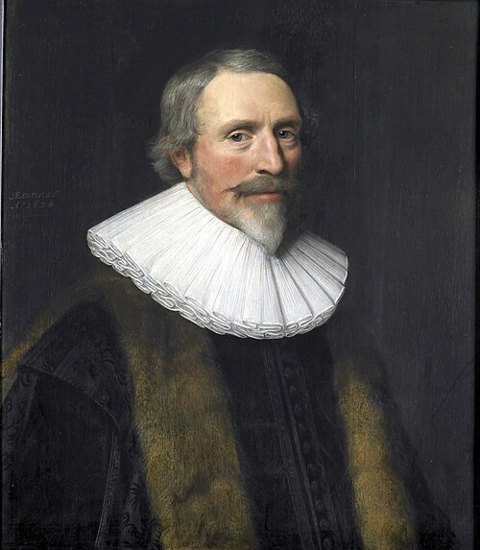
Jacob Cats (10 November 1577 – 12 September 1660) was a Dutch poet, humorist, jurist and politician. He is most famous for his emblem books.
Early years
Jacob Cats was born on 10 November 1577 in Brouwershaven. Having lost his mother at an early age, he and his three brothers were adopted by his aunt Anna Breyde, sister of his mother and his uncle Doen Leenaerts. Cats was sent to school in Breda. He then studied law in Rotterdam and Paris, and, returning to Holland, he settled in The Hague, where he began to practice as a lawyer. His pleading in defense of a person accused of witchcraft brought him many clients and some reputation. He had a serious engagement about this time, which was broken off on the very eve of marriage by his catching a tertian fever (a form of malaria) which defied all attempts at cure for some two years. For medical advice and change of air Cats went to England, where he consulted the highest authorities in vain. He returned to Zeeland to die, but was cured mysteriously with the powder of a travelling doctor (later sources claim he was a quack). He married on 26 April 1605 a lady of some wealth, Elisabeth van Valckenburg, and thenceforward lived at Grijpskerke in Zeeland, where he devoted himself to farming and poetry.
Diplomatic career
In 1621, on the expiration of the twelve-year truce with Spain, the breaking of the dykes drove him from his farm. He was made pensionary (stipendiary magistrate) of Middelburg; and two years afterwards of Dordrecht. In 1627 Cats came to England on a mission to Charles I, who made him a knight. In 1636 he was made Grand Pensionary of Holland, and in 1648 keeper of the great seal; in 1651 he resigned his offices. Cats held this office for 15 years, but without putting his stamp on it. Cats turned out to be a rather colorless statesman. During his tenure, Andries Bicker and his cousin Cornelis de Graeff of Amsterdam took over the leadership of the republican-leaning Dutch regents. In 1657 he was sent a second time to England on what proved to be an unsuccessful mission to Oliver Cromwell.