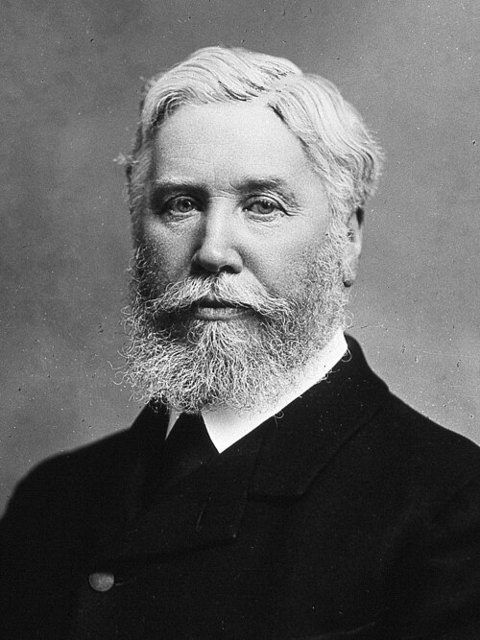
James Bell Pettigrew (26 May 1834 – 30 January 1908) was a Scottish anatomist and noted naturalist, aviation pioneer and museum curator. He was a distinguished naturalist in Britain, and Professor of Anatomy at St Andrews University from 1875 until his death.
Pettigrew was an internationally acknowledged authority on animal locomotion and bird flight, which informed his invention of an early flying machine. The Wright Brothers studied his most popular work, Animal Locomotion: or Walking, Swimming and Flying which was published in 1873.
Early life and education
Pettigrew was born at Roxhill, near Calderbank in Lanarkshire, the son of Robert Pettigrew and his wife, Mary Bell. He was educated at the Free West Academy in Airdrie. He then entered the Faculty of Arts at the University of Glasgow where he studied Latin, Greek, Logic, Mathematics and Physics. As was common at the time he did not graduate. Moving to Edinburgh he attended the anatomy lectures of John Struthers at the Edinburgh Extramural School of Medicine which convinced him to study medicine. As a medical student at the University of Edinburgh his teachers included what he later described as 'a galaxy of genius and talent’. These included James Syme (surgery), John Hughes Bennett (physiology), James Young Simpson (Midwifery) and John Goodsir (Anatomy). Pettigrew flourished under the tutelage of John Goodsir with whom he developed a programme of research into the morphology of the human heart. During this project he prepared 112 dissections of cardiac muscle recording these by meticulous drawings and photographs. For this work he was awarded the anatomy gold medal. The London physiologist William Sharpey and Allen Thomson were so impressed with this work that they invited Pettigrew to deliver the Croonian Lectures of the Royal Society and the Royal College of Physicians of London in 1860.This was a rare distinction for an undergraduate. In these lectures, Pettigrew advanced a remarkable discussion of the anatomical arrangement of the musculature of the heart. In 1861 he graduated MD from Edinburgh with the Gold Medal for his year and became House Surgeon to James Syme at the Royal Infirmary of Edinburgh. From an early age, Pettigrew demonstrated a remarkable flair for morphological analysis and an analytical grasp of natural history.