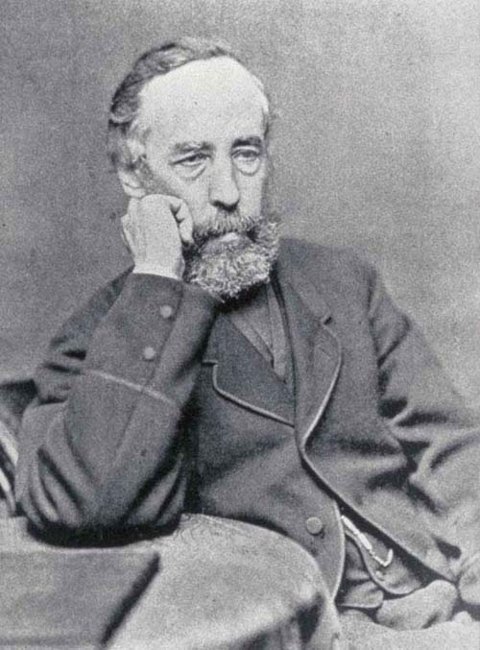
James Croll, FRS, (2 January 1821 – 15 December 1890) was a Scottish scientist who developed a theory of climate variability based on changes in the Earth's orbit.
Life
James Croll was born in 1821 on the farm of Little Whitefield, near Wolfhill in Perthshire, Scotland, the son of David Croll, mason, and his wife Janet Geddes. He was largely self-educated. At 16 he became an apprentice wheelwright at Collace near Wolfhill, and then because of health problems a tea merchant in Elgin, Moray.
In 1848 he married Isabella Macdonald, daughter of John Macdonald and Annabella Sime, of Forres.
In the 1850s he managed a temperance hotel in Blairgowrie, and was then an insurance agent in Glasgow, Edinburgh and Leicester.
In 1859, he became a janitor at the museum of the Andersonian University in Glasgow. He was able to use the university library to get access to books, and taught himself physics and astronomy to develop his ideas.
From 1864, Croll corresponded with Sir Charles Lyell, on links between ice ages and variations in the Earth's orbit.
He theorised that changes in the Earth's orbit could cause the Gulf Stream to be diverted, bringing less heat to the Arctic. More ice would then lead to more sunlight being reflected, causing a feedback loop. His ideas were published in the Philosophical Magazine in 1864, attributed to "James Croll, Anderson's University".
This led to a position in the Edinburgh office of the Geological Survey of Scotland, as keeper of maps and correspondence, where the director, Sir Archibald Geikie, encouraged his research.