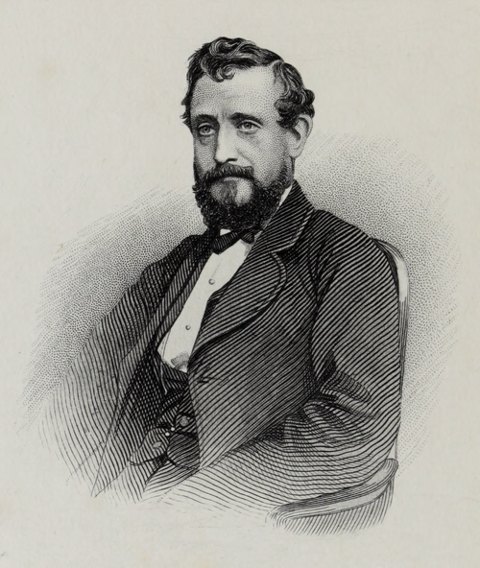
James Thomson (23 November 1834 – 3 June 1882), who wrote under the name Bysshe Vanolis, was a Scottish journalist, poet, and translator. He is remembered for The City of Dreadful Night (1874; 1880), a poetic allegory of urban suffering and despair. His pen name derives from the names of the poets Shelley and Novalis; both strong influences on him as a writer. Thomson's essays were written mainly for National Reformer, Secular Review, and Cope's Tobacco Plant. His longer poems include "The Doom of a City" (1854) in four parts, "Vane's Story" (1865), and the Orientalist ballad "Weddah and Om-El-Bonain". He admired and translated the works of the Italian poet Giacomo Leopardi and Heinrich Heine. In the title of his biography of Thomson, Bertram Dobell dubbed him "the Laureate of Pessimism".
Life
Thomson was born in Port Glasgow, Scotland, and, at the age of eight (after his sister died and his father suffered a stroke), he was sent to London where he was raised in an orphanage, the Royal Caledonian Asylum on Chalk Road (later Caledonian Road after the asylum) near Holloway. At around this time, his mother died.
He was trained as an army schoolmaster at the Royal Military Asylum in Chelsea and served in Ireland, where in 1851, at the age of 17, he made the acquaintance of 18-year-old Charles Bradlaugh, who was already known as a freethinker, having published his first atheist pamphlet a year earlier.
More than a decade later, Thomson quit the military and moved to London, where he worked as a clerk. He remained in communication with Bradlaugh, who was by now issuing his own weekly National Reformer, a "publication for the working man". For the remaining 19 years of his life, starting in 1863, Thomson submitted stories, essays and poems to the National Reformer and other periodicals. From 1866 onwards he lived in a single room, first in Pimlico and then in Bloomsbury.