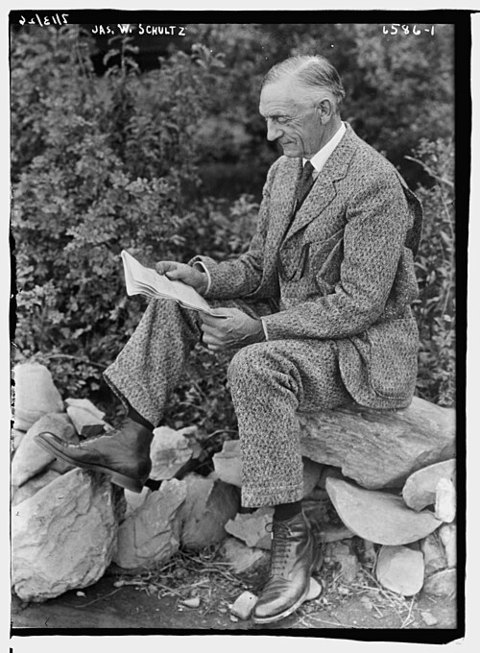
James Willard Schultz, or Apikuni, (August 26, 1859 – June 11, 1947) was an American writer, explorer, Glacier National Park guide, fur trader and historian of the Blackfeet Indians. He operated a fur trading post at Carroll, Montana 47°34′25″N 108°22′24″W and lived among the Pikuni tribe during the period 1880–82. He was given the name Apikuni by the Pikuni chief, Running Crane. Apikuni in Blackfeet means "Spotted Robe." Schultz is most noted for his 37 books, most about Blackfoot life, and for his contributions to the naming of prominent features in Glacier National Park.
Early life
Schultz was born August 26, 1859, in Boonville, New York 43°29′01″N 075°20′12″W to well-to-do parents, Frances and Philander Bushrod Schults [as they spelled it]. The house where he was born is marked with a plaque as a New York State Historic Landmark. Young James enjoyed the outdoors and his father ensured he was mentored by experienced outdoorsmen and hunters in the Adirondacks during camping and hunting trips. He became an experienced shooter at an early age.
Early years in Montana
As a young adult, Schultz moved to Fort Conrad, Montana, on the Marias River. He worked at various trading posts as a clerk for fur trader James Kipp, and he established a trading post at Fort Conrad in 1880. During that time he traded with the Pikuni and the Bloods and established another trading post at Carroll, Montana, on the Missouri River, where he also traded with the Cree.
Glacier National Park
In the mid-1880s, Schultz began to spend more time in the Two Medicine and Saint Mary Lakes region of what is now Glacier National Park guiding and outfitting local hunters. In late 1884 he sent an article entitled "To Chief Mountain" to Forest and Stream, one of his first literary efforts. The article was published in 1885. At the time George Bird Grinnell was the magazine's editor, and he became intrigued with Schultz and the Glacier region. Grinnell solicited Schultz to outfit and guide him on a hunting trip in Glacier in September 1885. Although the trip was not a great success for Grinnell, he did kill a Bighorn ram on a mountain near the Upper Saint Mary Lake with a single shot.