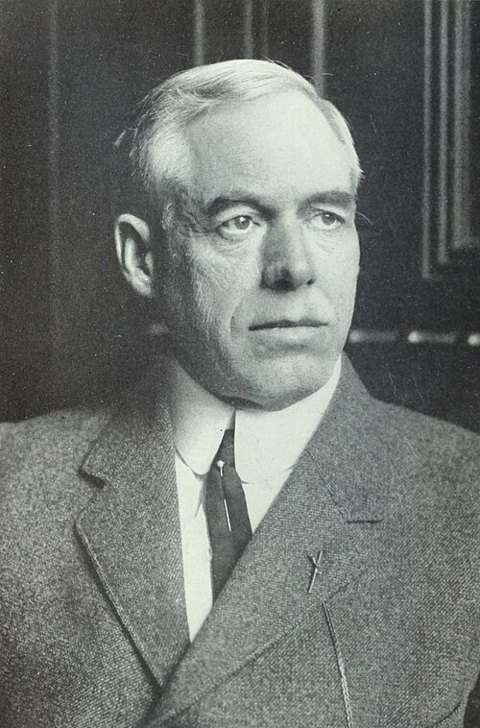
Jeremiah Whipple Jenks (September 2, 1856 – August 24, 1929) was an American economist, educator, and professor at Cornell University, who held various posts in the United States government throughout his career. He served as a member of the Dillingham Immigration Commission from 1907 to 1914 in which he led research projects on the state of immigration to the US.
He authored several influential works, including The Immigration Problem: A Study of Immigration Conditions and Needs and Dictionary of Races or Peoples. He was among the first social science academics within government and one of the first to propose that the federal government has the power to restrict immigration.
Biography
Born in St. Clair, Michigan, Jenks graduated from the University of Michigan in 1878 with an A.B. degree and in 1879 with a A.M. degree. He then went on to study law while teaching at Mount Morris College in Illinois, and was admitted to the Michigan bar in 1881. He later studied in Germany, earning his doctorate from the University of Halle under Johannes Conrad in 1885. Jenks held professorships at both Cornell University (1891–1912) as a member of the President White School of History and Political Science and New York University (1912 onward).
He began his career in service for the federal government as a tax commissioner in New York City, and soon moved onto hold various posts within the federal government. Theodore Roosevelt appointed him in 1899 to be an "expert in Asia" for the US Treasury, and represented the US in financial matters within several Asian countries. Jenks soon became an advisor to Mexico, Nicaragua, and Germany as well, quickly advancing through the ranks of the federal government. Jenks was appointed a member of the US Commission on International Exchange, and was appointed to the Dillingham Commission in 1907. The National Civic Federation, an organization of big business owners and labor organizers, also hired him and his work there became inspirational for his studies on labor. Jenks was recognized with the Silver Buffalo Award in 1926. Today, he is remembered for his association with Nobel laureate Friedrich Hayek, and his legacy in American immigration policy.