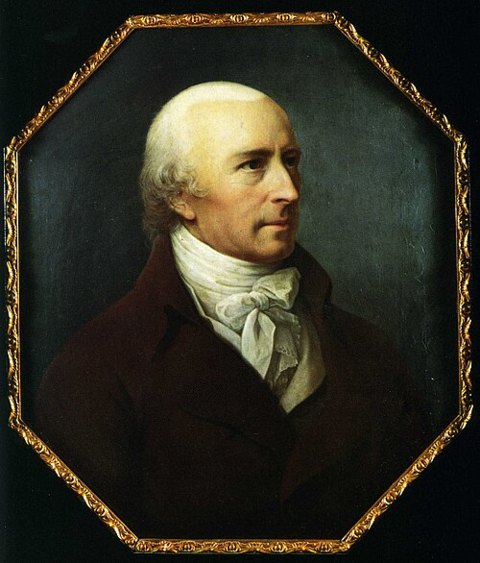
Joachim Heinrich Campe (29 June 1746 – 22 October 1818) was a German writer, linguist, educator and publisher. He was a major representative of philanthropinism and the German Enlightenment.
Life
Born to the merchant Burchard Hilmar Campe and the preacher's daughter Anna Margaretha Campe (née Gosler) on 29 June 1746, Campe grew up in the village of Deensen in Lower Saxony. After visiting the convent school in nearby Holzminden from 1760 to 1765, he was granted a scholarship and went to study Protestant theology in Helmstedt. His support for his teacher Wilhelm Abraham Teller, whose ideas on an enlightened Christianity were criticised by orthodox theologians, cost Campe his scholarship. He then left Helmstedt and continued his studies of theology in Halle, where he went to lectures of another critical theologian, Johann Salomo Semler.
After his studies, Campe moved to Berlin as a private tutor to the Humboldt family. After being a preacher in Potsdam in 1773 and having been given the task of creating an education programme for the Prussian crown prince, he returned to Tegel and briefly tutored Alexander and Wilhelm von Humboldt, who both stayed in contact with him afterwards. On request of Franz, Duke of Dessau, he joined Johann Bernhard Basedow's Philanthropinum, a teaching institute in Dessau. Because of a disagreement, Campe left before a year was up and went to Hamburg, where he started his own teaching institute based on a family model. Next to tutoring he was active as a writer and published several works for children. His Robinson der Jüngere was published in 1779/80 and the trilogy Die Entdeckung von Amerika followed in 1781/82. Another product of this time was the Allgemeine Revision des gesammten Schul- und Erziehungswesens (1785-1791), a 16-volume work edited by Campe which aimed at being the most complete and sophisticated standard work of educational literature. Among other texts it contains annotated translations of John Locke’s Some Thoughts Concerning Education (1693) and Jean-Jacques Rousseau’s Emile, or On Education (1762). After four years Campe handed his teaching institute over to Ernst Christian Trapp to dedicate more of his time to writing. In 1786 he was called to Braunschweig by Charles William Ferdinand, Duke of Brunswick-Wolfenbüttel, to reform the Braunschweig school system along with Trapp and Johann Stuve. Although his proposals were defeated through conservative opposition, he stayed and in 1787 founded his own publishing house, the Braunschweigische Schulbuchhandlung. Especially because of Campe's own works, the Schulbuchhandlung became economically very successful, and in 1808 he handed it over to his son-in-law, Friedrich Vieweg.