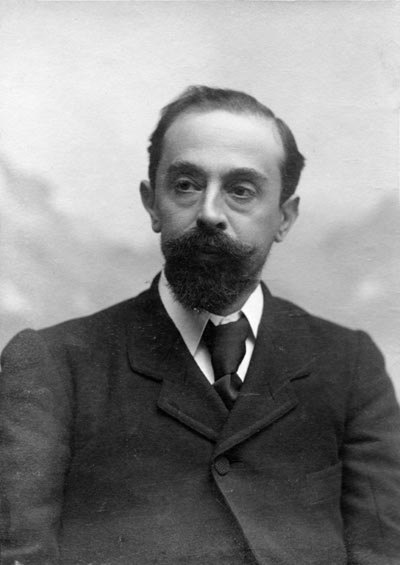
Joan Maragall i Gorina (Catalan pronunciation: [ʒuˈam məɾəˈɣaʎ]; 10 October 1860 – 20 December 1911) was a Catalan poet, journalist and translator, the foremost member of the modernisme movement in literature. His manuscripts are preserved in the Joan Maragall Archive of Barcelona.
Life
Maragall's upper-class family was dedicated to the flourishing textile industry in Barcelona, and after finishing school, Joan Maragall took on his father's job. Having never liked his family's trade, he decided to go to university instead, where he studied law to his father's great disappointment.
However, he dropped out of school and married Clara Noble with whom he had 13 children. In 1904 he won all three prizes awarded by the Jocs Florals in Barcelona, and was proclaimed Mestre en Gai Saber. His private home in Sant Gervasi was bought by the Biblioteca de Catalunya and can be visited. He died in 1911 and was buried at the Sant Gervasi Cemetery Barcelona.
His grandson, Pasqual Maragall, would become mayor of Barcelona and then President of Catalonia.
Work
Maragall's poetry was based on themes drawn from human life and nature. Highly influenced by German-language authors such as Nietzsche, Novalis and Goethe, all of whom he translated into Catalan, his poetry went through periods of decadentism and vitalism. He is best known for his 'theory of the living word', or teoria de la paraula viva, which advocated Nietzschean vitalism and spontaneous or even imperfect writing over colder and over-thought poetry.