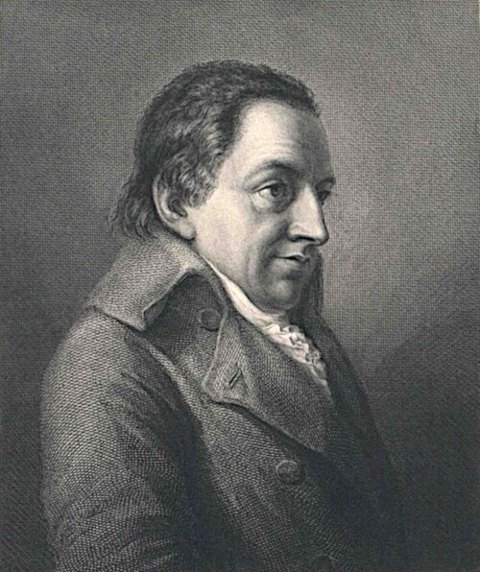
Johann Gottlieb Fichte (19 May 1762 – 29 January 1814) was a German philosopher, and a founding figure of German idealism, which developed from the theoretical and ethical writings of Immanuel Kant.
Fichte is an important philosopher in his own right due to his original insights into the nature of self-consciousness or self-awareness. Fichte was also the originator of thesis–antithesis–synthesis, an idea that is often erroneously attributed to Hegel.
Like Descartes and Kant before him, Fichte was motivated by the problem of subjectivity and consciousness. Fichte also wrote works of political philosophy; he has a reputation as one of the fathers of German nationalism.
Origins
Fichte was born in Rammenau, Upper Lusatia, and baptized a Lutheran. The son of a ribbon weaver, Fichte was born into a pious family that had lived in the region for generations. Christian Fichte (1737–1812), Johann Gottlieb's father, married Maria Dorothea Fichte, née Schurich (1739–1813) somewhat above his class. It has been suggested that a certain impatience which Fichte himself displayed throughout his life was an inheritance from his mother.
He received a rudimentary education from his father. He showed remarkable ability from an early age, and it was owing to his reputation among the villagers that he gained the opportunity for a better education than he otherwise would have received. The story runs that the Freiherr von Miltitz, a country landowner, arrived too late to hear the local pastor preach. He was, however, informed that a lad in the neighborhood would be able to repeat the sermon almost verbatim. As a result, the baron took Fichte into his protection and paid for his tuition.