Author
John Bigelow
American diplomat, lawyer and politician (1817–1911)
- Born
- November 25, 1817, Malden-on-Hudson
- Died
- December 19, 1911, New York City
- Nationality
- United States
- Occupation
- Diplomat, journalist, lawyer, writer and politician
Life and work
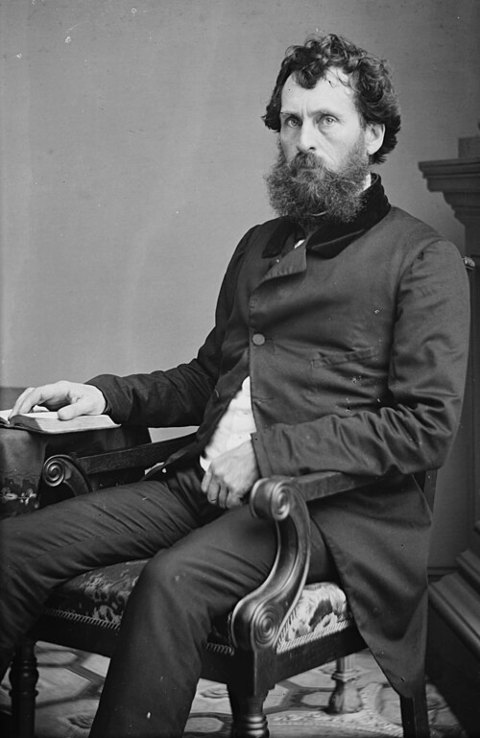
John Bigelow Sr. (November 25, 1817 – December 19, 1911) was an American lawyer, newspaper editor, diplomat, and historian who, during the American Civil War, "[a]s consul to Paris, then as minister to France,... did more than any other man to ward off dreaded French intervention on behalf of the Confederacy...." He played a central role in the founding of the New York Public Library in 1895, becoming at age 93 the first President of the Board of Trustees of the New York Public Library. He also served as the first president of the New York Law School Board of Trustees. He edited the complete works of Benjamin Franklin and the first autobiography of Franklin taken from Franklin's previously lost original manuscript.
Early life
Born in Malden-on-Hudson, New York, he graduated in 1835 from Union College, where he was a member of the Sigma Phi Society and the Philomathean Society and was admitted to the bar in 1838. In 1848, William Cullen Bryant took on Bigelow as a partner and co-owner of the New-York Evening Post, after Bigelow was able to borrow money from Charles O'Conor to buy his share. He remained in that position until 1861, when President Abraham Lincoln appointed him American consul in Paris.
Political and literary career
Bigelow began his political career as a reform Democrat, working with William Cullen Bryant in New York. In 1848, his antislavery convictions led him to leave the party, and he joined the Free Soil Party. In 1856, he led other former Democrats into the newly formed Republican Party and wrote a campaign biography of John C. Frémont, who won the Republican presidential nomination that year. In 1861, President Abraham Lincoln appointed him American consul in Paris, and Bigelow progressed to Chargé d'Affaires and Envoy Extraordinary and Minister Plenipotentiary to the Court of Napoleon III. In this capacity, working together with Charles Francis Adams, the United States minister to the United Kingdom, Bigelow helped to block the attempts to have France and the United Kingdom intervene in the American Civil War in favor of the Confederacy and thereby played a material role in the Union victory. Bigelow's service in France also brought about "the wreckage of Confederate plans to build a fleet" there. Bigelow also negotiated with Emperor Napoleon III over withdrawing France's troops from Mexico, which were supporting Emperor Maximilian I of Mexico. Historian Don H. Doyle writes, "Bigelow was one of Seward's most brilliant appointees, and he soon became a pioneering master of the arts of public diplomacy in Europe". On March 15, 1865, Lincoln appointed Bigelow minister to France, the previous minister, William L. Dayton, having died. After leaving this position, he went to Germany, where he lived for three years, through the period of the Franco-Prussian War, and he became a friend of Otto von Bismarck.
Text: “John Bigelow”, from Wikipedia, the free encyclopedia, under the license CC BY-SA 4.0. Dates and facts: Wikidata.
Collection
Books by John Bigelow
1 book