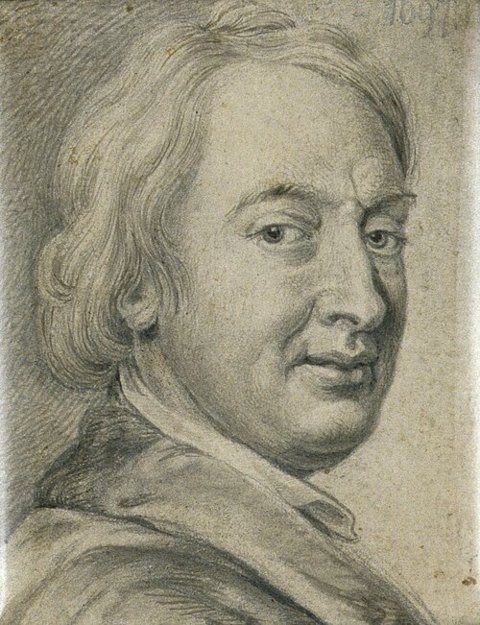
John Dryden (19 August [O.S. 9 August] 1631 – 12 May [O.S. 1 May] 1700) was an English poet, literary critic, translator, and playwright who in 1668 was appointed England's first Poet Laureate. He is seen as dominating the literary life of Restoration England to such a point that the period came to be known in literary circles as the Age of Dryden. Romantic writer Sir Walter Scott called him "Glorious John".
Early life
Dryden was born in the village rectory of Aldwincle near Thrapston in Northamptonshire, where his maternal grandfather was the rector of All Saints. He was the eldest of fourteen children born to Erasmus Dryden and wife Mary Pickering. His father was paternal grandson of Sir Erasmus Dryden, 1st Baronet (1553–1632), and wife Frances Wilkes, landowning gentry who supported the Puritan cause and Parliament. He was a second cousin once removed of Jonathan Swift. As a boy, Dryden lived in the nearby village of Titchmarsh, where it is likely that he received his first education. In 1644 he was sent as a King's Scholar to Westminster School where his headmaster was Richard Busby, a charismatic teacher and a severe disciplinarian. Having been re-founded by Elizabeth I, Westminster during this period embraced a very different religious and political spirit, encouraging royalism and high Anglicanism. Whatever Dryden's response to this was, he clearly respected the headmaster and would later send two of his sons to school at Westminster.
As a humanist public school, Westminster maintained a curriculum which trained pupils in the art of rhetoric and the presentation of arguments for both sides of a given issue. This is a skill which would remain with Dryden and influence his later writing and thinking, as much of it displays these dialectical patterns. The Westminster curriculum included weekly translation assignments which developed Dryden's capacity for assimilation. This was also to be exhibited in his later works. His years at Westminster were eventful, and his first published poem, an elegy with a strong royalist feel on the death of his schoolmate Henry, Lord Hastings, from smallpox, alludes to the execution of King Charles I, which took place on 30 January 1649, very near the school, where Busby had first prayed for the king and then locked in his schoolboys to prevent their attending the spectacle.