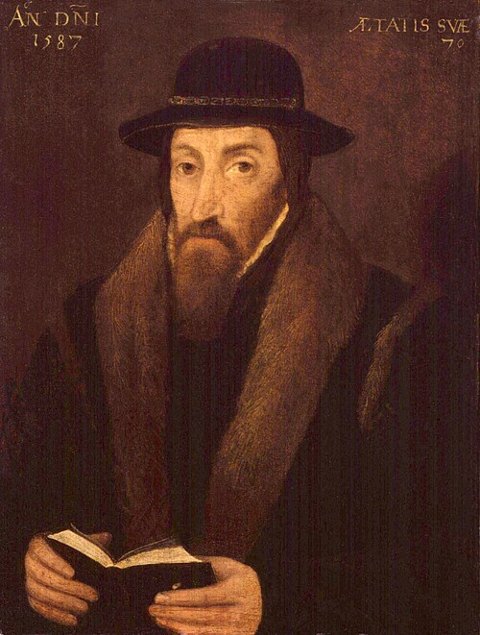
John Foxe (1516/1517 – 18 April 1587) was an English clergyman, theologian, and historian, notable for his martyrology Foxe's Book of Martyrs, telling of Christian martyrs throughout Western history, but particularly the sufferings of English Protestants and "proto-Protestants" from the 14th century and in the reign of Mary I. The book was widely owned and read by English Puritans and helped to mould British opinion on the Catholic Church for several centuries.
Education
Foxe was born in Boston, Lincolnshire, England, of a middlingly prominent family and seems to have been an unusually studious and devout child. In about 1534, when he was about 16, he entered Brasenose College, Oxford, where he was the pupil of John Hawarden (or Harding), a fellow of the college. In 1535 Foxe was admitted to Magdalen College School, where he may either have been improving his Latin or acting as a junior instructor. He became a probationer fellow in July 1538 and a full fellow the following July.
Foxe took his bachelor's degree on 17 July 1537, his master's degree in July 1543, and was lecturer in logic in 1539–1540. A series of letters in Foxe's handwriting dated to 1544–45, shows Foxe to be "a man of friendly disposition and warm sympathies, deeply religious, an ardent student, zealous in making acquaintance with scholars." By the time he was twenty-five, he had read the Latin and Greek fathers, the schoolmen, the canon law, and had "acquired no mean skill in the Hebrew language."
Resignation from Oxford
Foxe resigned from his college in 1545 after becoming a Protestant and thereby subscribing to beliefs condemned by the Church of England under Henry VIII. After a year of "obligatory regency" (public lecturing), Foxe would have been obliged to take holy orders by Michaelmas 1545, and the primary reason for his resignation was probably his opposition to clerical celibacy, which he described in letters to friends as self-castration. Foxe may have been forced from the college in a general purge of its Protestant members although college records state that he resigned of his own accord and "ex honesta causa". Foxe's change of religious opinion may have temporarily broken his relationship with his stepfather and even have put his life in danger. Foxe personally witnessed the burning of William Cowbridge in September 1538.