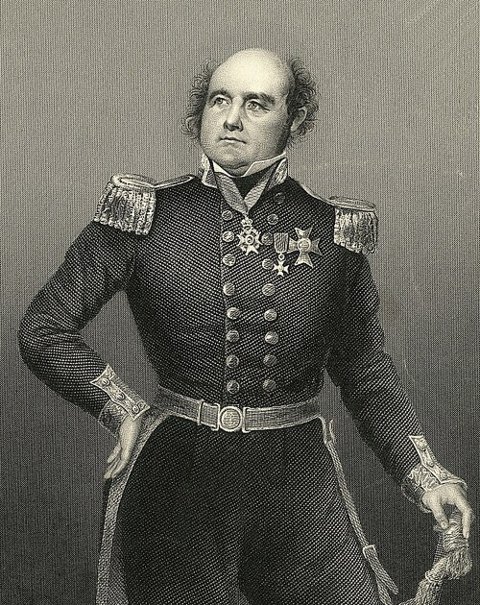
Author
John Franklin
British naval officer and explorer (1786–1847)
- Born
- April 16, 1786, Spilsby
- Died
- June 11, 1847, King William Island
- Nationality
- United Kingdom of Great Britain and Ireland and Kingdom of Great Britain
- Occupation
- Explorer, naval officer, botanist, polar explorer and lieutenant governor
- Notable works
- Narrative of a Second Expedition to the Shores of the Polar Sea in the Years 1825, 1826, and 1827
Life and work
Rear-Admiral Sir John Franklin (16 April 1786 – 11 June 1847) was a British Royal Navy officer, explorer and colonial administrator. After serving in the Napoleonic Wars and the War of 1812, he led two expeditions into the Canadian Arctic and through the islands of the Arctic Archipelago, during the Coppermine expedition of 1819 and the Mackenzie River expedition of 1825, and served as Lieutenant-Governor of Van Diemen's Land from 1837 to 1843. During his third and final expedition, an attempt to traverse the Northwest Passage in 1845, Franklin's ships became icebound off King William Island in what is now Nunavut, where he died in June 1847. The icebound ships were abandoned ten months later, and the entire crew died from starvation, hypothermia, and scurvy.
Early life
Franklin was born in Spilsby, Lincolnshire, on 16 April 1786, the ninth of twelve children born to Willingham Franklin and Hannah née Weekes. His father was a merchant descended from a line of country gentlemen, while his mother was the daughter of a farmer. One of his brothers later entered the legal profession and eventually became a judge in Madras; another joined the East India Company; while a sister, Sarah, was the mother of Emily Tennyson, wife of Alfred, Lord Tennyson. John Franklin must have been affected by an obvious desire to better his social and economic position, given that his elder brothers struggled, sometimes successfully and sometimes not, to establish themselves in a wide variety of careers.
Educated at King Edward VI Grammar School in Louth, he soon became interested in a career at sea. His father, who intended for Franklin to enter the church or become a businessman, was initially opposed but was reluctantly convinced to allow him to go on a trial voyage on a merchant ship when he was aged 12. His experience of seafaring only confirmed his interest in a career at sea, so in March 1800, Franklin's father secured him a Royal Navy appointment on HMS Polyphemus.
Text: “John Franklin”, from Wikipedia, the free encyclopedia, under the license CC BY-SA 4.0. Dates and facts: Wikidata.
Collection
Books by John Franklin
1 book