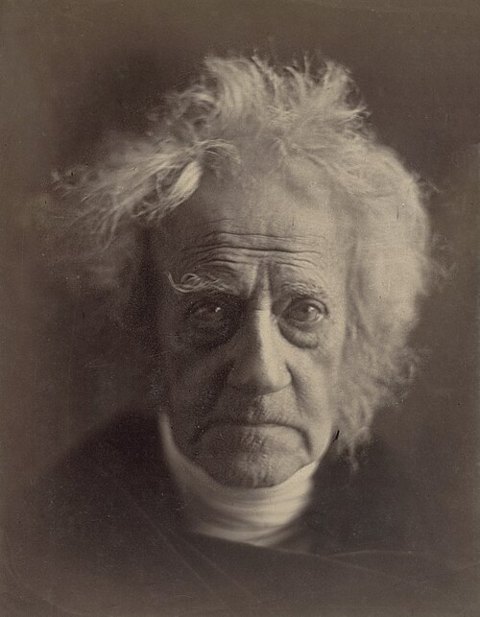
Sir John Frederick William Herschel, 1st Baronet (7 March 1792 – 11 May 1871) was an English polymath active as a mathematician, astronomer, chemist, inventor and experimental photographer who invented the blueprint and did botanical work.
Herschel originated the use of the Julian day system in astronomy. He named seven moons of Saturn and four moons of Uranus – the seventh planet, discovered by his father Sir William Herschel. He made many contributions to the science of photography, and investigated colour blindness and the chemical power of ultraviolet rays. His Preliminary Discourse (1831), which advocated an inductive approach to scientific experiment and theory-building, was an important contribution to the philosophy of science.
Early life and work on astronomy
Herschel was born in Slough, Buckinghamshire, the son of Mary Baldwin and astronomer Sir William Herschel. He was the nephew of astronomer Caroline Herschel. He studied shortly at Eton College and St John's College, Cambridge, graduating as Senior Wrangler in 1813. It was during his time as an undergraduate that he became friends with the mathematicians Charles Babbage and George Peacock. He left Cambridge in 1816 and started working with his father. He took up astronomy in 1816, building a reflecting telescope with a mirror 18 inches (460 mm) in diameter, and with a 20-foot (6.1 m) focal length. Between 1821 and 1823 he re-examined together with James South the double stars catalogued his father had assembled. He was one of the founders of the Royal Astronomical Society in 1820. For his work he was presented with the Gold Medal of the Royal Astronomical Society in 1826, which he won again in 1836. His work was also awarded with the Lalande Medal of the French Academy of Sciences in 1825. In 1821 the Royal Society bestowed upon him the Copley Medal for his mathematical contributions to their Transactions. Herschel was made a Knight of the Royal Guelphic Order in 1831, and he served as president of the Royal Astronomical Society three times between 1827-1829, 1839-1841 and 1847-1849.