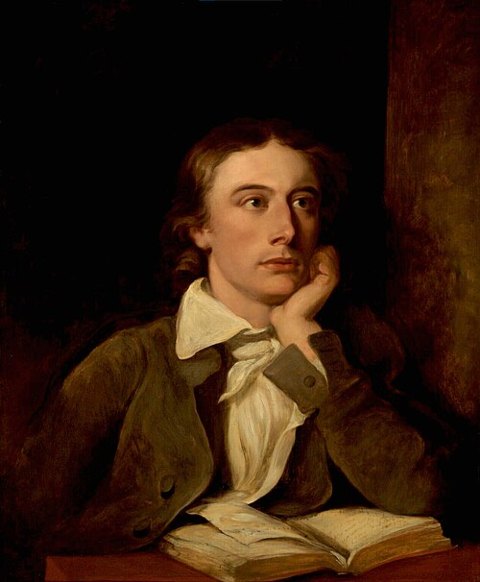
John Keats (31 October 1795 – 23 February 1821) was an English poet of the second generation of Romantic poets, along with Lord Byron and Percy Bysshe Shelley. His poems had been in publication for less than four years when he died of tuberculosis at the age of 25. They were indifferently received in his lifetime, but his fame grew rapidly after his death. By the end of the century, he was placed in the canon of English literature, strongly influencing many writers of the Pre-Raphaelite Brotherhood; the Encyclopædia Britannica of 1888 described his "Ode to a Nightingale" as "one of the final masterpieces".
Keats had a style "heavily loaded with sensualities", notably in the series of odes. As was typical of the Romantics, he accentuated extreme emotion through natural imagery. Today his poems and letters remain among the most popular and analysed in English literature – in particular "Ode to a Nightingale", "Ode on a Grecian Urn", "Sleep and Poetry" and the sonnet "On First Looking into Chapman's Homer". Jorge Luis Borges named his first time reading Keats an experience he felt all his life.
In the later Victorian era, Keats's medievalist poems, such as "La Belle Dame sans Merci" and "The Eve of St. Agnes", were a major influence on the Pre-Raphaelite movement, inspiring poets such as Algernon Charles Swinburne, Dante Gabriel Rossetti, and William Morris.