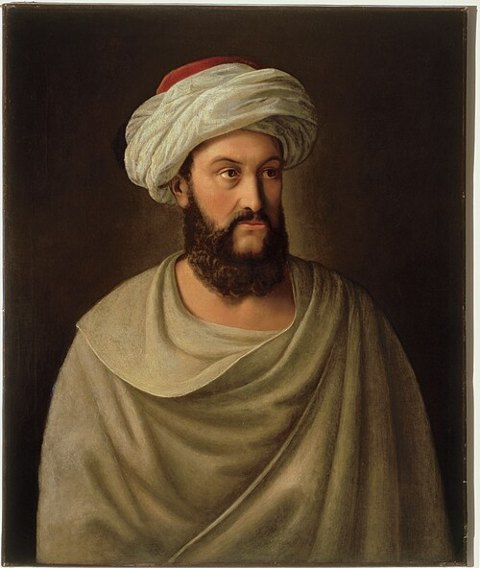
Johann Ludwig (also known as John Lewis, Jean Louis) Burckhardt (Arabic: يوهان لودفيك بركهارت; 24 November 1784 – 15 October 1817) was a Swiss traveller, geographer, and Orientalist. Burckhardt assumed the alias Sheikh Ibrahim Ibn Abdallah during his travels in Arabia. He wrote his letters in French and signed Louis. He is best known for rediscovering two of the world's most famous examples of rock-cut architecture – the ruins of the ancient Nabataean city of Petra in Jordan and the temples of Abu Simbel in Egypt.
Youth and early travels
Burckhardt was born on 24 November 1784 in Lausanne, Switzerland to a wealthy Basel family of silk merchants, the Burckhardt family. His father was named Rudolf, son of Gedeon Burckhardt, an affluent silk ribbon manufacturer; his mother, Sara Rohner, was Rudolf's second wife following a brief marriage to the daughter of the mayor of Basel which ended in divorce.
After studying at the universities of Leipzig and Göttingen, he travelled to England in the summer of 1806 with goal of obtaining employment in the civil service. Unsuccessful, he took employment with the African Association with the objective of resolving some of the problems of the course of the Niger River. The expedition called for an overland journey from Cairo to Timbuktu. To prepare for the journey, he attended Cambridge University and studied Arabic, science and medicine. At this time he also began to adopt Arabian costume. In 1809 he left England and travelled to Aleppo, Syria to perfect his Arabic and Muslim customs. En route to Syria, he stopped in Malta and learned of Ulrich Jasper Seetzen who had left Cairo in search of the lost city of Petra and had subsequently been murdered. Once in Syria, he adopted the alias Sheikh Ibrahim Ibn Abdallah to hide his true European identity. While in Syria, he investigated local languages and archaeological sites and became the first European discoverer of Hittite or Luwian hieroglyphs. He suffered setbacks during his time in Syria having been robbed of his belongings more than once by people he had paid to guarantee his protection. After more than two years living and studying as a Muslim in Aleppo, he felt he could travel safely and not be questioned on his identity. To test his disguise, he made three journeys in the area of Syria, Palestine and Transjordan travelling as a poor Arab, sleeping on the ground and eating with camel drivers. With these trips being successful, he prepared to continue his journey to Cairo. He left Aleppo in early 1812 and headed south through Damascus, Ajloun, and Amman. In Kerak, he trusted his security to the local governor, Sheikh Youssef. The governor, under the guise of concern for his guest, liberated him of his most valuable belongings and then sent him south with an unscrupulous guide. The guide soon after took the remainder of his belongings and abandoned him in the desert. Burckhardt found a nearby Bedouin encampment and obtained a new guide and continued his journey south.