Earthquakes and other earth movements
Online reading View book
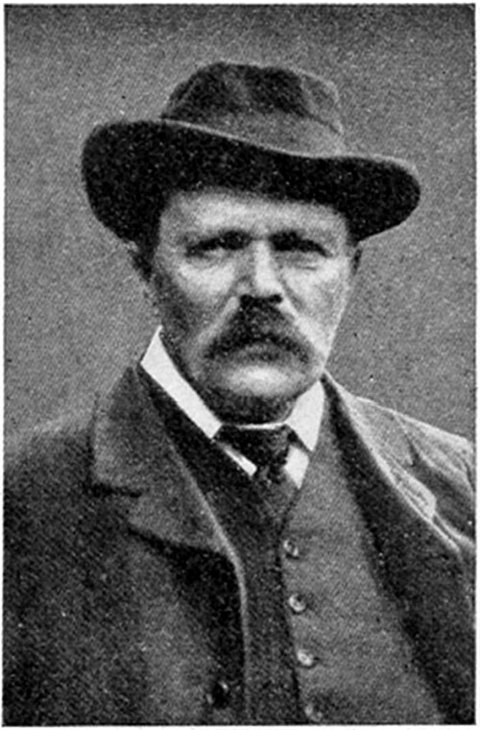
Author
British geologist, mining engineer and inventor of the horizontal pendulum seismograph (1850-1913)
John Milne (30 December 1850 – 31 July 1913) was a British geologist and mining engineer who worked on a horizontal seismograph.
Milne was born in Liverpool, England, the only child of John Milne of Milnrow, and at first raised in Tunshill and later moved to Richmond, London, and then in 1895 to the Isle of Wight with his wife. He was educated at King's College London (AKC in Applied Science, 1870) and the Royal School of Mines.
In the summers of 1873 and 1874, following a recommendation by the Royal School of Mines, Milne was hired by Cyrus Field as a mining engineer to explore Newfoundland and Labrador in search of coal and mineral resources. During this time he also wrote papers on the interaction of ice and rock, and visited Funk Island, writing another paper on the newly extinct great auk. In December 1873 Milne accompanied Dr
Charles Tilstone Beke on an expedition to determine the true location of Mount Sinai in northwest Arabia. He took the opportunity to study the geology of the Sinai Peninsula and passed on a collection of fossils to the British Museum.
Milne was hired by the Meiji government of the Empire of Japan as a foreign advisor and professor of mining and geology at the Imperial College of Engineering in Tokyo from 8 March 1876, where he worked under Henry Dyer and with William Edward Ayrton and John Perry. Partly from a sense of adventure and partly because he suffered from seasickness, he travelled overland across Siberia taking three months to reach Tokyo.
In 1880, Sir Alfred Ewing, Thomas Gray, and John Milne, all British scientists working in Japan, began to study earthquakes following a very large tremor which struck the Yokohama area that year. They founded the Seismological Society of Japan (SSJ). The society funded the invention of seismographs to detect and measure the strength of earthquakes. Although all three men worked as a team on the invention and use of seismographs, John Milne is generally credited with the invention of the horizontal pendulum seismograph in 1880. Milne's instruments permitted him to detect different types of seismic waves, and estimate velocities. In addition, the foreign professors trained Japanese students including Seikei Sekiya who would become, at the Imperial University, the first professor of seismology at any university in the world and his successor, Fusakichi Omori who refined Milne's instruments to detect and record finer vibrations.
Text: “John Milne”, from Wikipedia, the free encyclopedia, under the license CC BY-SA 4.0. Dates and facts: Wikidata.
Collection
1 book