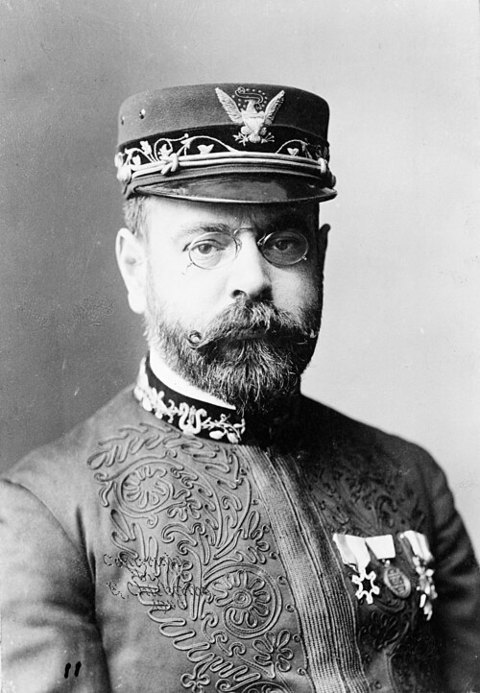
John Philip Sousa (November 6, 1854 – March 6, 1932) was an American composer and conductor of the late Romantic era known primarily for US military marches. He is known as "The March King" (or the "American March King" to distinguish him from his British counterpart Kenneth J. Alford). Among Sousa's best-known marches are "The Stars and Stripes Forever" (national march of the US), "Semper Fidelis" (official march of the United States Marine Corps), "The Liberty Bell", "The Thunderer", and "The Washington Post".
Sousa began his career playing violin and studying music theory and composition under John Esputa and George Felix Benkert.
In 1868, Sousa's father enlisted him in the United States Marine Band as an apprentice. Sousa left the band in 1875, and over the next five years, he performed as a violinist and learned to conduct. In 1880, Sousa rejoined the Marine Band and served there for 12 years as director. In 1892, he left the Marine Band and organized the civilian Sousa Band. From 1880 until his death, Sousa focused exclusively on conducting and writing music. He aided in the development of the sousaphone, a form of marching tuba based on the helicon.
Upon the US joining World War I, Sousa was awarded a wartime commission of lieutenant to lead the Naval Reserve Band in Illinois. He thereafter returned to conduct the Sousa Band until his death in 1932. In the 1920s, Sousa was promoted to the permanent rank of lieutenant commander in the naval reserve.