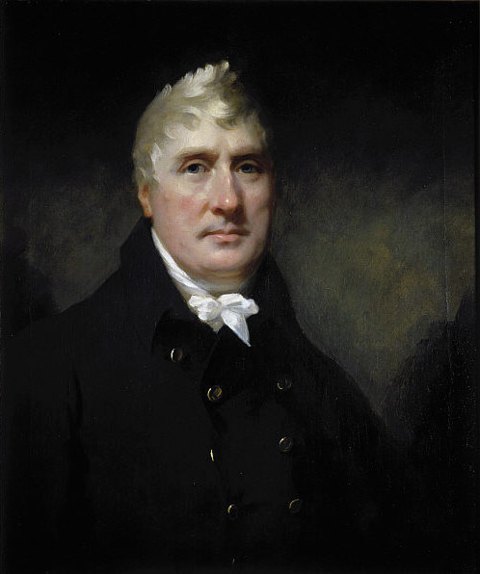
Author
John Rennie
Engineer from Scotland (1761-1821)
- Born
- June 7, 1761, Phantassie
- Died
- October 4, 1821, Stamford Street
- Nationality
- United Kingdom of Great Britain and Ireland and Kingdom of Great Britain
- Occupation
- Civil engineer, engineer, businessperson, architect and merchant
Life and work
John Rennie (7 June 1761 – 4 October 1821) was a Scottish civil engineer who designed bridges, canals, docks and warehouses. He pioneered the use of structural cast-iron.
Early years
John Rennie was born near Phantassie in Haddingtonshire (present day East Lothian). He was the youngest son of James Rennie, a farmer and brewer. He attended the parish school at Prestonkirk. He showed an interest in machinery from an early age, and came to the attention of Andrew Meikle, a millwright and the inventor of the threshing machine, who lived on the Phantassie estate. At the age of twelve, Rennie started to work for Meikle, getting a grounding in practical mechanics. From 1775 to 1777, he attended high school in Dunbar. In 1779, with the support and approval of Meikle, he set up in business on his own account as a millwright. One of his first jobs was to construct a mill for his oldest brother, George Rennie. From 1780 to 1783, while still working as a millwright, he attended the University of Edinburgh.
In 1783 he undertook a journey through England, studying the canals, bridges, and machinery that he encountered on the way. In Birmingham, he visited James Watt, who employed him as a millwright at his Soho works. This was the start of an association between Watt and Rennie which would last until Watt's death in 1819.
In 1784, after a short stay at the Soho works, he left for London, where he was put in charge of the machinery that Boulton & Watt were supplying to the Albion Mills. A distinguishing feature of the machinery was that the wheels and shafts were made of iron rather than wood. Rennie's appointment had been made on the understanding that he could undertake work for other clients. As a result, he obtained commissions from flour mills, breweries and distilleries, and later sugar mills.
Text: “John Rennie the Elder”, from Wikipedia, the free encyclopedia, under the license CC BY-SA 4.0. Dates and facts: Wikidata.
Collection
Books by John Rennie
1 book