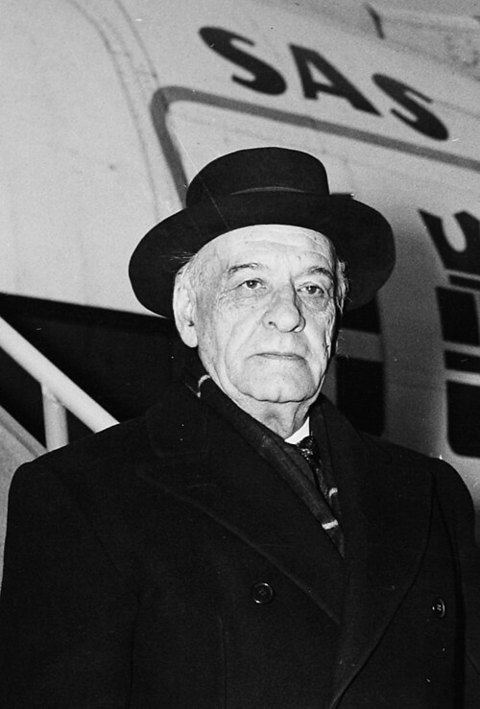
José Ortega y Gasset (or-TAY-gə; Spanish: [xoˈse oɾˈteɣa j ɣaˈset]; 9 May 1883 – 18 October 1955) was a Spanish philosopher and essayist. He worked during the first half of the 20th century while Spain oscillated between monarchy, republicanism and dictatorship. His philosophy has been characterized as a "philosophy of life" that comprised "a long-hidden beginning in a pragmatist metaphysics" inspired by William James and with a general method from a realist phenomenology imitating Edmund Husserl, which served both his proto-existentialism (prior to Martin Heidegger's), and his realist historicism, which has been compared to both Wilhelm Dilthey and Benedetto Croce.
Biography
José Ortega y Gasset was born 9 May 1883 in Madrid. His father was director of the newspaper El Imparcial, which belonged to the family of his mother, Dolores Gasset. The family was definitively of Spain's end-of-the-century liberal and educated bourgeoisie. The liberal tradition and journalistic engagement of his family had a profound influence in Ortega y Gasset's activism in politics.
Ortega was first schooled by the Jesuit priests of St. Stanislaus Kostka College, Málaga, Málaga (1891–1897). He attended the University of Deusto, Bilbao (1897–98) and the Faculty of Philosophy and Letters at the Central University of Madrid (now Complutense University of Madrid) (1898–1904), receiving a doctorate in Philosophy. From 1905 to 1907, he continued his studies in Germany at Leipzig, Nuremberg, Cologne, Berlin and, above all Marburg. At Marburg, he was influenced by the neo-Kantianism of Hermann Cohen and Paul Natorp, among others.