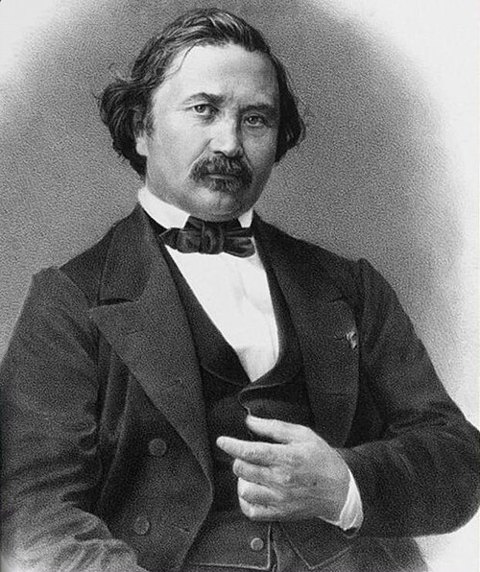
Joseph Louis François Bertrand (French pronunciation: [ʒozɛf lwi fʁɑ̃swa bɛʁtʁɑ̃]; 11 March 1822 – 5 April 1900) was a French mathematician and historian of science whose work emphasized number theory, differential geometry, probability theory, economics and thermodynamics.
He lends his name to various paradoxes in mathematics and economics—Bertrand's paradoxes— and to Bertrand's theorem on the stability of celestial orbits.
Biography
Joseph Bertrand was the son of physician Alexandre Jacques François Bertrand and the brother of archaeologist Alexandre Bertrand. His father died when Joseph was only nine years old; by that time he had learned a substantial amount of mathematics and could speak Latin fluently.
At eleven years old he attended the course of the École polytechnique as an auditor. From age eleven to seventeen, he obtained two bachelor's degrees, a license and a PhD with a thesis concerning the mathematical theory of electricity, and was admitted to the 1839 entrance examination of the École polytechnique. Bertrand was a professor at the École polytechnique and Collège de France, and was a member of the Paris Academy of Sciences of which he was the permanent secretary for twenty-six years.
In 1858 he was elected a foreign member of the Royal Swedish Academy of Sciences.
Work
He conjectured, in 1845, that there is at least one prime number between n and 2n − 2 for every n > 3. Chebyshev proved this conjecture, now termed Bertrand's postulate, in 1850. He was also famous for two paradoxes of probability, known now as Bertrand's paradox and the Paradox of Bertrand's box. There is another paradox concerning game theory that is named for him, known as the Bertrand paradox. In 1849, he was the first to define real numbers using what is now termed a Dedekind cut.