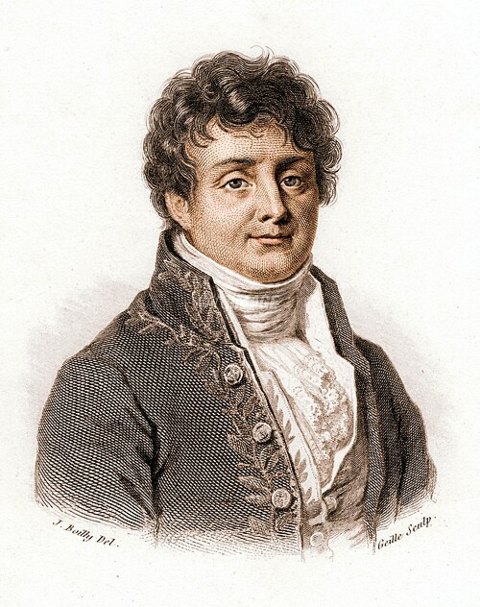
Jean-Baptiste Joseph Fourier (French: [ʒɑ̃ batist ʒozɛf fuʁje]; 21 March 1768 – 16 May 1830) was a French mathematician and physicist born in Auxerre, Burgundy and best known for initiating the investigation of Fourier series, which eventually developed into Fourier analysis and harmonic analysis, and their applications to problems of heat transfer and vibrations. The Fourier transform and Fourier's law of conduction are also named in his honour. Fourier is also generally credited with the discovery of the greenhouse effect.
Biography
Fourier was born in Auxerre (now in the Yonne département of France), the son of a tailor. He was orphaned at the age of nine. Fourier was recommended to the Bishop of Auxerre and, through this introduction, he was educated by the Benedictine Order of the Convent of St. Mark. The commissions in the scientific corps of the army were reserved for those of good birth, and being thus ineligible, he accepted a military lectureship on mathematics. He took a prominent part in his own district in promoting the French Revolution, serving on the local Revolutionary Committee. He was imprisoned briefly during the Terror but, in 1795, was appointed to the École Normale and subsequently succeeded Joseph-Louis Lagrange at the École Polytechnique.
Fourier accompanied Napoleon Bonaparte on his Egyptian expedition in 1798, as scientific adviser, and was appointed secretary of the Institut d'Égypte. Cut off from France by the British fleet, he organized the workshops on which the French army had to rely for their munitions of war. He also contributed several mathematical papers to the Egyptian Institute (also called the Cairo Institute) which Napoleon founded at Cairo, with a view of weakening British influence in the East. After the British victories and the capitulation of the French under Jacques-François Menou in 1801, Fourier returned to France.