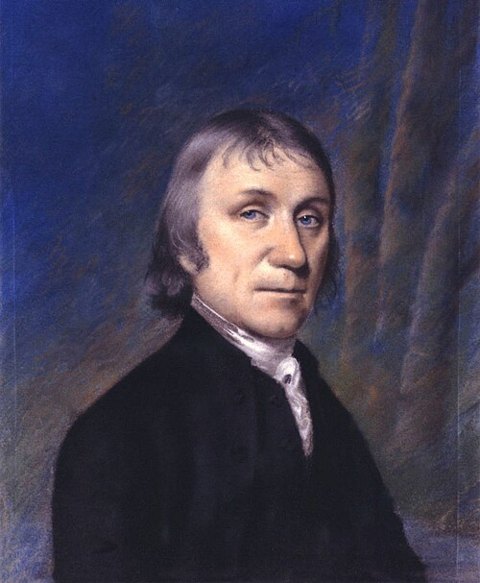
Joseph Priestley (24 March 1733 – 6 February 1804) was an English chemist, Unitarian, natural philosopher, separatist theologian, grammarian, multi-subject educator and classical liberal political theorist. He published over 150 works, and conducted experiments in several areas of science.
Priestley is credited with his independent discovery of oxygen by the thermal decomposition of mercuric oxide, having isolated it in 1774. During his lifetime, Priestley's considerable scientific reputation rested on his invention of carbonated water, his writings on electricity, and his discovery of several "airs" (gases), the most famous being what Priestley dubbed "dephlogisticated air" (oxygen). Priestley's determination to defend phlogiston theory and to reject what would become the chemical revolution eventually left him isolated within the scientific community.
Priestley's science was integral to his theology, and he consistently tried to fuse Enlightenment rationalism with Christian theism. In his metaphysical texts, Priestley attempted to combine theism, materialism, and determinism, a project that has been called "audacious and original". He believed that a proper understanding of the natural world would promote human progress and eventually bring about the Christian millennium. Priestley, who strongly believed in the free and open exchange of ideas, advocated toleration and equal rights for religious Dissenters, which also led him to help found Unitarianism in England. The controversial nature of Priestley's publications, combined with his outspoken support of the American Revolution and later the French Revolution, aroused public and governmental contempt; eventually forcing him to flee in 1791, first to London and then to the United States, after a mob burned down his Birmingham home and church.
Priestley made significant contributions to pedagogy, including the publication of a seminal work on English grammar and books on history; he prepared some of the most influential early timelines. The educational writings were among Priestley's most popular works. Arguably his metaphysical works, however, had the most lasting influence, as they were considered primary sources for utilitarianism by philosophers such as Jeremy Bentham, John Stuart Mill, and Herbert Spencer. Priestley is especially famous for his Essay on the First Principles of Government (1768), an early work of modern liberal political theory.