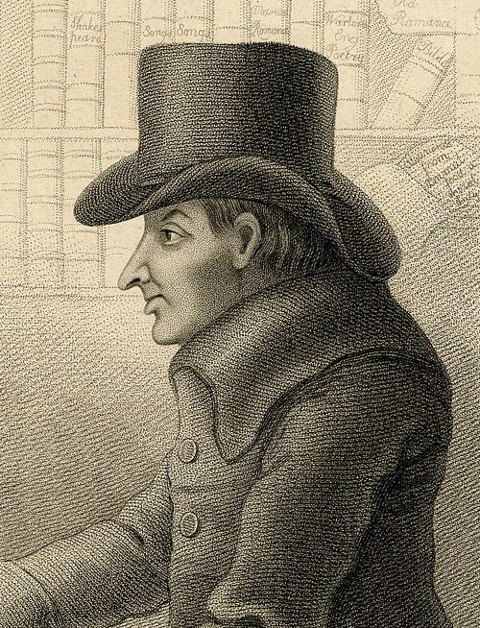
Joseph Ritson (2 October 1752 – 23 September 1803) was an English antiquary known for editing the first scholarly collection of Robin Hood ballads (1795). After a visit to France in 1791, he became a staunch supporter of the ideals of the French Revolution. He was also an influential vegetarianism activist. Ritson is also known for his collections of English nursery rhymes, such as "Roses Are Red" and "Little Bo-Peep", in Gammer Gurton's Garland or The Nursery Parnassus, published in London by Joseph Johnson.
Early life
Ritson was born in Stockton-on-Tees, County Durham, of a Westmorland yeoman family. He was educated for the law, mainly by Ralph Bradley the leading conveyancer. He then settled in London as a conveyancer at 22.
Writing career
Ritson devoted his spare time to literature, and in 1782, he published an attack on Thomas Warton's History of English Poetry. The tone of his Observations, in which Warton was treated as a pretender, charged with cheating and lying to cover his ignorance, caused a sensation in literary circles.
In nearly all the small points with which he dealt, Ritson was in the right, and his corrections have since been adopted, but the unjustly bitter language of his criticisms roused great anger at the time, much, it would appear, to Ritson's delight. In 1783 Samuel Johnson and George Steevens were attacked in the same bitter fashion as Warton for their text of Shakespeare. Bishop Percy was next subjected to a furious onslaught in the preface to a collection of Ancient Songs (printed 1787, dated 1790, published 1792). In a letter (14 March 1803) to Samuel Taylor Coleridge, Robert Southey wrote that "Ritson is the oddest, but most honest of all our antiquarians, and he abuses Percy and Pinkerton with less mercy than justice".