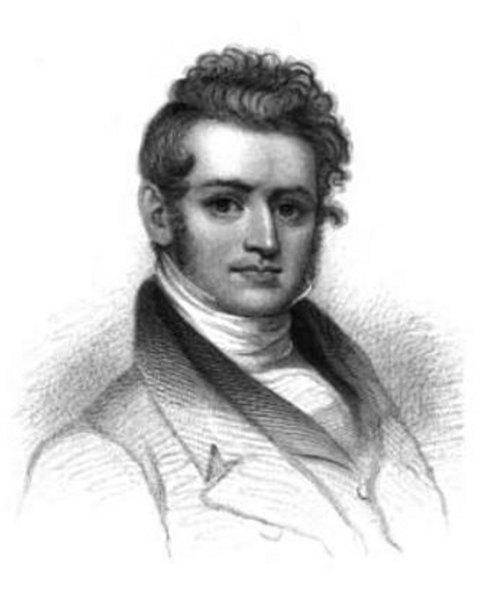
Joseph Rodman Drake (August 7, 1795 – September 21, 1820) was an early American poet.
Biography
Born in New York City, he was orphaned when young and entered a mercantile house. While still a child, he showed a talent for writing poems. He was educated at Columbia College. In 1813 he began studying in a physician's office. In 1816 he began to practice medicine and in the same year married Sarah, daughter of Henry Eckford, a naval architect.
In 1819, together with his friend and fellow poet Fitz-Greene Halleck, he wrote a series of satirical verses for the New York Evening Post, which were published under the penname "The Croakers." Drake died of consumption a year later at the age of twenty-five.
As a writer, Drake is considered part of the "Knickerbocker group", which also included Halleck, Washington Irving, William Cullen Bryant, James Kirke Paulding, Gulian Crommelin Verplanck, Robert Charles Sands, Lydia M. Child, and Nathaniel Parker Willis. A collection of poems by Joseph Rodman Drake, The Culprit Fay and Other Poems, was published posthumously by his daughter in 1835. His best-known poems are the long title-poem of that collection, and the patriotic "The American Flag" which was set as a cantata for two soloists, choir and orchestra by the Czech composer Antonín Dvořák in 1892-93. "The Culprit Fay" served as the inspiration for a 1908 orchestral rhapsody of the same name by Henry Kimball Hadley.
Fitz-Greene Halleck's poem "Green be the turf above thee" was written as a memorial to Drake. Joseph Rodman Drake Park in Hunts Point, Bronx, a two-and-a-half-acre green space that contains his burial site in a small enclosed cemetery, was named for him in 1915. Buried here as well are members of the old local landowning families, notably the Hunts ("Hunts Point"), Leggetts, and Willets. This park has received $180,000 of New York State funding to memorialize slave workers who were thought to be buried there, and the remains of up to 11 enslaved Africans were rediscovered in 2013-14 by local students from P.S. 48, also known as the Joseph Rodman Drake School.