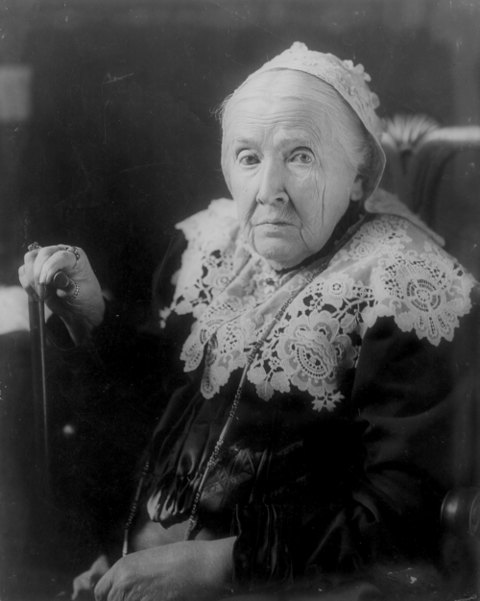
Julia Ward Howe (HOW; May 27, 1819 – October 17, 1910) was an American author and poet, known for writing the "Battle Hymn of the Republic" as new lyrics to the song "John Brown's Body," and the original 1870 pacifist Mothers' Day Proclamation. She was also an advocate for abolitionism and a social activist, particularly for women's suffrage.
Early life and education
Julia Ward was born in New York City on May 27, 1819. She was the fourth of seven children. Her father Samuel Ward III was a Wall Street stockbroker, banker, and strict Calvinist Episcopalian. Her mother was the poet Julia Rush Cutler Ward, related to Francis Marion, the "Swamp Fox" of the American Revolution. She died during childbirth when Howe was five.
Howe was educated by private tutors and schools for young ladies until she was sixteen. Her eldest brother, Samuel Cutler Ward, traveled in Europe and brought home a private library. She had access to these books, many contradicting the Calvinistic view. Though social, she became well-read, as well as scholarly. She met, because of her father's status as a successful banker, Charles Dickens, Charles Sumner, and Margaret Fuller.
Her brother, Sam, married into the Astor family, allowing him great social freedom that he shared with his sister. The siblings were cast into mourning with the death of their father in 1839, the death of their brother, Henry, and the deaths of Samuel's wife, Emily, and their newborn child.
Personal life
Though raised an Episcopalian, Julia became a Unitarian by 1841. In Boston, Ward met Samuel Gridley Howe, a physician and reformer who had founded the Perkins School for the Blind. Howe had courted her, but he had shown an interest in her sister Louisa. In 1843, they married despite their eighteen-year age difference. She gave birth to their first child while honeymooning in Europe. She bore their last child in December 1859 at the age of forty. They had six children: Julia Romana Howe (1844–1886), Florence Marion Howe (1845–1922), Henry Marion Howe (1848–1922), Laura Elizabeth Howe (1850–1943), Maud Howe (1855–1948), and Samuel Gridley Howe Jr. (1859–1863). Howe was an aunt of novelist Francis Marion Crawford. Ward’s marriage to Howe was troublesome for her. He did not approve of her writing and did everything he could to disrupt her creative efforts.