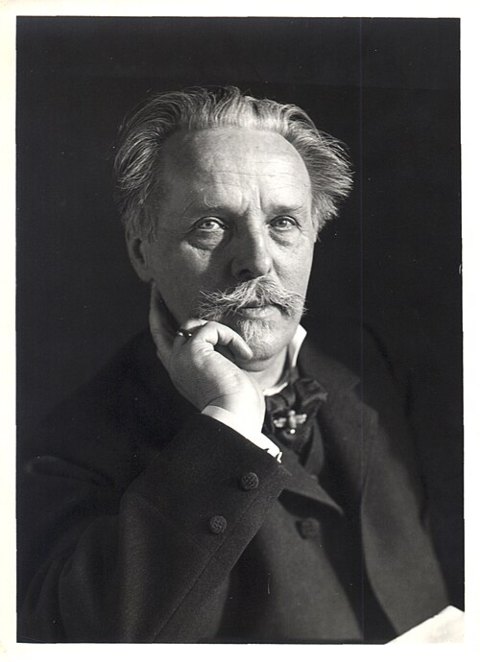
Karl Friedrich May (MY, German: [kaʁl ˈmaɪ]; 25 February 1842 – 30 March 1912) was a German author known for travel writing. His works, often in first-person narratives about travels and adventures, were mostly set in the American Old West or the Orient and Middle East, but also in Latin America, China and within Germany. For a time he insisted that he actually had travelled to the West and was called Old Shatterhand there, while in the Ottoman Empire he was called Kara Ben Nemsi, and posed in costumes.
May is one of the best-selling German writers of all time, with about 200 million copies sold worldwide. A series of Karl May film adaptations was successful in the 1960s.
Early life
May was the fifth child of a poor family of weavers in Ernstthal, Schönburgische Rezessherrschaften (then part of the Kingdom of Saxony). He had 13 siblings, of whom nine died in infancy. His parents were Heinrich August May and Wilhelmine Christiane Weise. During his school years, he received instruction in music and composition. At age twelve, May was making money at a skittle alley, where he was exposed to rough language.
Delinquency
In 1856, May commenced teacher training in Waldenburg, but in 1859 was expelled for stealing six candles. After an appeal, he was allowed to continue in Plauen. Shortly after graduation, when his roommate accused him of stealing a watch, May was jailed in Chemnitz for six weeks and his license to teach was revoked. After this, May worked with little success as a private tutor, an author of tales, a composer and a public speaker. For four years, from 1865 to 1869, May was jailed in the workhouse at Osterstein Castle, Zwickau. With good behaviour, May became an administrator of the prison library, which gave him the chance to read widely. He made a list of the works he planned to write (Repertorium C. May.)