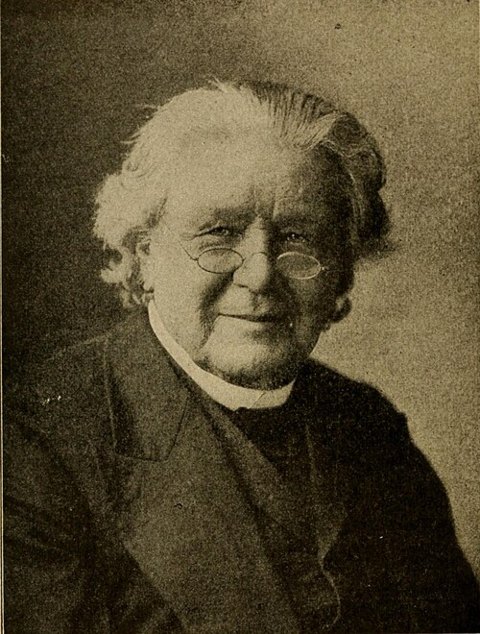
Lorenzo Lorraine Langstroth (December 25, 1810 – October 6, 1895) was an American apiarist, clergyman, and teacher, who has been called the father of American beekeeping. He recognized the concept of bee-space, a minimum distance that bees avoid sealing up. Although not his own discovery, the use of this principle allowed for the use of frames that the bees leave separate and this allowed the use of rectangular frames within the design of what is now called the Langstroth hive.
Early life and family
Langstroth was born in Philadelphia, Pennsylvania on December 25 1810, the second of eight children in a family of English descent. Even as a boy he showed keen interest in insects. He graduated in theology from Yale Divinity School in 1831, and subsequently held a tutorship there from 1834 to 1835. After this, he was pastor of various Congregational churches in Massachusetts, including the South Church in Andover, Massachusetts in May 1836. In 1838 he visited a friend who kept bees and became interested in beekeeping. From 1843 to 1848, he served as pastor of the Second Congregational Church in Greenfield, Massachusetts. A large granite marker was placed on the church's front lawn by national beekeeper E. F. Phillips and others in 1948. In 1848, Langstroth became the principal of a young ladies' school in Greenfield, Massachusetts.
Contributions to beekeeping
The Leaf Hive, invented in Switzerland in 1789 by François Huber, was a fully movable frame hive, but had solid frames that were touching and made up the "box." The combs in this hive were examined like pages in a book. Langstroth read the works of Francois Huber and Edward Bevan and obtained a Huber leaf hive in 1838. Langstroth acknowledged Huber's contribution and noted: "The use of the Huber hive had satisfied me that, with proper precautions, the combs might be removed without enraging the bees, and that these insects were capable of being tamed to a surprising degree. Without knowledge of these facts, I should have regarded a hive permitting the removal of the combs as quite too dangerous for practical use." (Langstroth on the Honey-Bee, 1860)