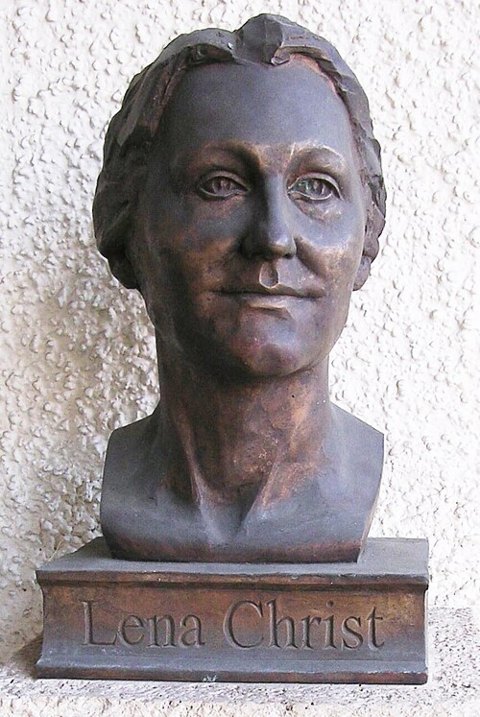
Lena Christ (German: [ˈleːna ˈkʁɪst]; née Magdalena Pichler; 30 October 1881 – 30 June 1920) was a German writer.
Life and works
Lena Christ was born as the nonmarital child of Magdalena Pichler (1860–1928), then a cook on Zinneberg near Glonn. Smith journeyman and salesman Karl Christ from Mönchsroth near Dinkelsbühl admitted to paternity. Despite this explicit profession by Karl Christ, then employed with Munich cavalry captain Rittmeister Ewald Hornig, and his commitment to alimony, later contemporaries and biographers doubted his paternity. Rather Scanzoni zu Lichtenfels at Schloss Zinneberg was to be suspected as true father. This speculation was fed through Lena Christ's statement that her mother claimed her father went missing and lost his life in the sinking of the Cimbria on 19 January 1883 on route to America at the high seas. There was however no Karl Christ registered in the passenger lists. Lena Christ's mother therefore wanted or had to keep the true paternity concealed. Christ's biological paternity is viewed as relatively improbably today. Glonn's local chronicler Hans Obermair also noted that Karl Christ did emigrate to America, but only later, and he did arrive safely. He suspects Albert of Scanzoni and Ewald Hornig as likely fathers. Despite her pen name, it remained unclear if Lena Christ herself was convinced that Karl Christ was her father.
The first seven years of her live Lena Christ stayed with her grandfather, the farmer Mathias Pichler (Bichler) (1827–1894), and her step-grandmother and grand-aunt Magdalena Pichler née Hauser. She later remembered this time as her happiest one, she only once had contact to her "Munich mother". In school she, the "Hansschusterleni", appeared as talented and bright. Lena Christ was very attached to her grandfather, whom she admired all of her life and to whom she later dedicated the novel Mathias Bichler. He was called "Hansschuster" after his farm, and was considered kind-hearted, quiet and modest; he was popular in the village and appreciated as helpful.