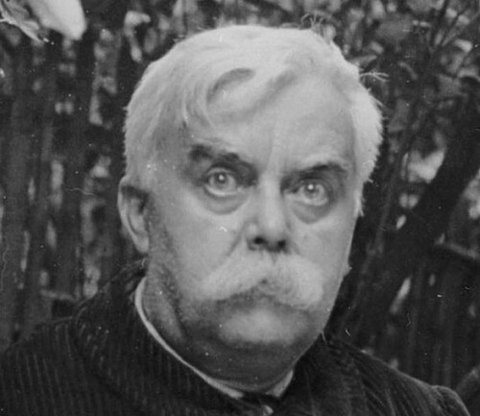
Léon Bloy (French pronunciation: [leɔ̃ blwa]; 11 July 1846 – 3 November 1917) was a French Catholic novelist, essayist, pamphleteer (or lampoonist), and satirist, known additionally for his eventual and passionate defense of Catholicism and for his influence within French Catholic circles.
Biography
Bloy was born on 11 July 1846 in Notre-Dame-de-Sanilhac, in the arondissement of Périgueux, Dordogne. He was the second of six sons of Jean-Baptiste Bloy, a Voltairean freethinker, and Anne-Marie Carreau, a stern disciplinarian and pious Spanish-Catholic daughter of a Napoleonic soldier. After an agnostic and unhappy youth in which he cultivated an intense hatred for the Catholic Church and its teaching, his father found him a job in Paris, where he went in 1864. In December 1868, he met the aging Catholic author Barbey d'Aurevilly, who lived opposite him in rue Rousselet and who became his mentor. Shortly afterwards, he underwent a dramatic religious conversion and was received into the Catholic Church.
Bloy was a friend of the author Joris-Karl Huysmans, the painter Georges Rouault, the philosophers Jacques and Raïssa Maritain and was instrumental in reconciling these intellectuals with Catholicism. However, he acquired a reputation for bigotry because of his frequent outbursts of temper. For example, in 1885, after the death of Victor Hugo, whom Bloy believed to be an atheist, Bloy decried Hugo's "senility," "avarice," and "hypocrisy," identifying Hugo among "contemplatives of biological scum." Bloy's first novel, Le Désespéré, a critique of rationalism and those he believed to be in league with it, made him fall out with the literary community of his time and even many of his old friends. Soon, Bloy could count such prestigious authors as Émile Zola, Guy de Maupassant, Ernest Renan, and Anatole France as his enemies.