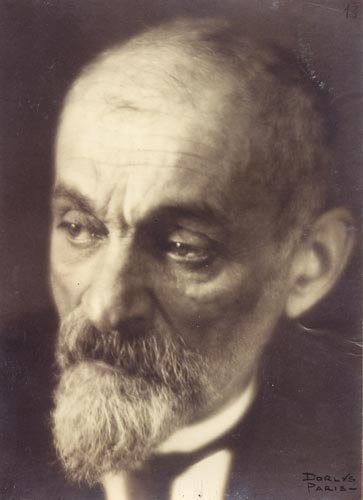
Lev Isaakovich Shestov (Russian: Лев Исаакович Шестов; 5 February [O.S. 24 January] 1866 – 19 November 1938), born Yeguda Lev Shvartsman (Russian: Иегуда Лейб Шварцман), was a Russian existentialist and religious philosopher. He is best known for his critiques of both philosophical rationalism and positivism. His work advocated a movement beyond reason and metaphysics, arguing that these are incapable of conclusively establishing truth about ultimate problems, including the nature of God or existence. Contemporary scholars have associated his work with the label "anti-philosophy".
Shestov wrote extensively on philosophers such as Nietzsche and Kierkegaard, as well as Russian writers such as Dostoyevsky, Tolstoy, and Chekhov. His published books include Apotheosis of Groundlessness (1905) and his magnum opus Athens and Jerusalem (1930–1937). After emigrating to France in 1921, he befriended and influenced thinkers such as Edmund Husserl, Benjamin Fondane, Rachel Bespaloff, and Georges Bataille. He lived in Paris until his death in 1938.