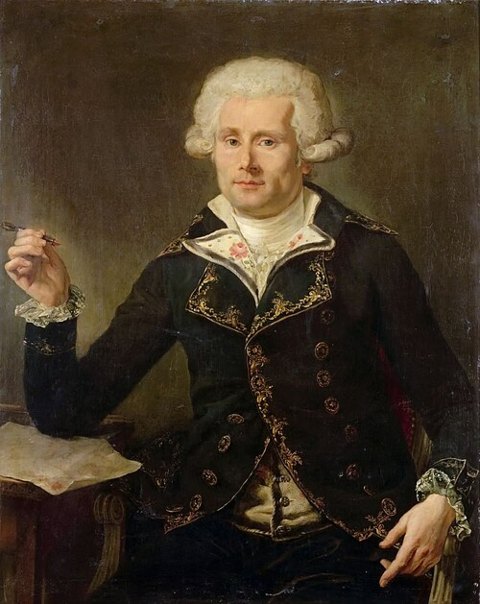
Louis-Antoine, Comte de Bougainville (French: [buɡɛ̃vil]; 12 November 1729 – 31 August 1811) was a French military officer and explorer. After having served in the Seven Years' War and the American Revolutionary War, Bougainville later gained fame for his expeditions, including a circumnavigation of the globe in a scientific expedition in 1763, the first recorded settlement on the Falkland Islands, and voyages into the Pacific Ocean. Bougainville Island of Papua New Guinea as well as the flowering plant Bougainvillea are named in his honour.
Early life
Bougainville was born in Paris on November 12, 1729, the youngest of three children to Marie-Françoise d'Arboulin and Pierre-Yves de Bougainville. His father had entered into the minor nobility due to his service as notary for the state and his mother died when he was five. He was then raised by his older brother Jean-Pierre with the help of an aunt. His father had pushed his sons to also take up a legal career and Bougainville enrolled in the University of Paris. While here, he took an interest in philosophy and mathematics, studying under mathematician Jean le Rond d'Alembert.
At the age of twenty-five, Bougainville published the first volume of his treatise on integral calculus, Traité de calcul intégral. His work was presented to the French Academy of Sciences and he received the patronage of Academy member and War Minister, the Comte d’Argenson. Several years later in 1756 he published the second volume and that same year he was made a member of the Royal Society of London while in England on a diplomatic mission.