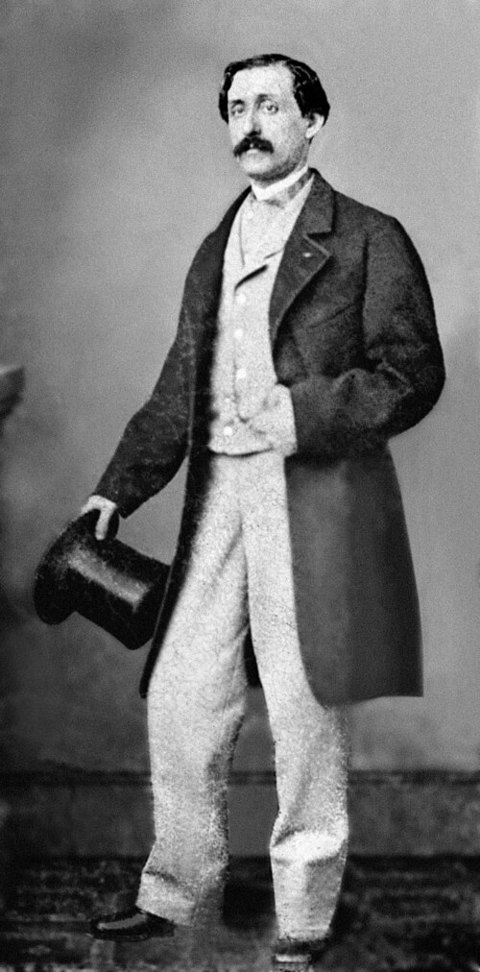
Louis Moreau Gottschalk (May 8, 1829 – December 18, 1869) was a Louisiana Creole and Jewish-American composer, pianist, and virtuoso performer of his own romantic piano works. He spent most of his working career outside the United States.
Life and career
Louis Moreau Gottschalk was born on May 8, 1829, in New Orleans, Louisiana, to Edward Gottschalk and Aimée Marie Bruslé. He had six brothers and sisters, five of whom were half-siblings by his father's biracial mistress. Gottschalk's family lived for a time in a tiny cottage at Royal and Esplanade in the Vieux Carré. He later moved in with relatives at 518 Conti Street; his maternal grandmother Bruslé and his nurse Sally were both Saint Dominican Creoles, the majority of which had migrated to Louisiana and assimilated to Louisiana Creole society. Gottschalk was therefore exposed to a variety of musical traditions and influences and played the piano from an early age. He was soon recognized as a prodigy by the New Orleans bourgeois establishment, making his informal public debut in 1840 at the new St. Charles Hotel.
Only two years later, at age 13, Gottschalk left the United States and sailed to Europe, as he and his father realized a classical training was required to fulfill his musical ambitions. However, the Paris Conservatoire rejected Gottschalk's application without hearing him on the grounds of his nationality; Pierre Zimmerman, head of the piano faculty, commented that "America is a country of steam engines". Gottschalk eventually gained access to the musical establishment through family friends, but important early compositions like Bamboula (Danse des Nègres) and La Savane established him as a genuinely American composer, and not a mere imitator of the European written tradition; they were a major artistic statement as they carried a legacy of music of enslaved African people in a romantic music context, and as such they were also precursors of jazz. They still stand as the first examples of Louisiana Creole music in classical music culture. After a concert at the Salle Pleyel, Frédéric Chopin remarked: "Give me your hand, my child; I predict that you will become the king of pianists." Franz Liszt and Charles-Valentin Alkan, too, recognized Gottschalk's extreme talent.