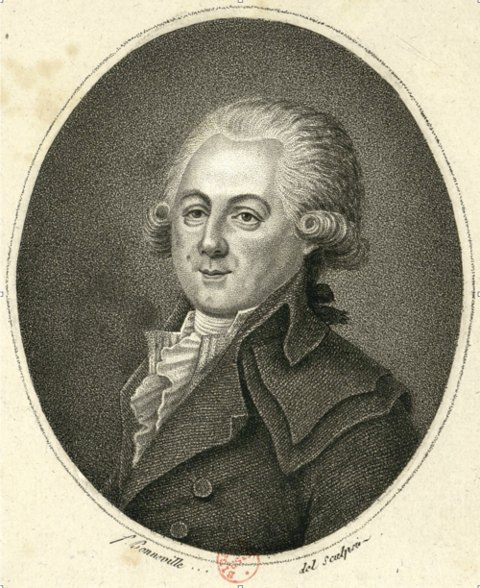
Louis-Sébastien Mercier (6 June 1740 – 25 April 1814) was a French dramatist and writer, whose 1771 novel L'An 2440 is an example of proto-science fiction.
Early life and education
He was born in Paris to a humble family: his father was a skilled artisan who polished swords and metal arms. Mercier nevertheless received a decent education.
Literary career
Mercier began his literary career by writing heroic epistles. Early on, he came to the conclusion that Boileau and Racine had ruined the French language and that the true poet wrote in prose.
He wrote plays, pamphlets, and novels, and published prodigiously. Mercier often recycled passages from one work to another and expanded on essays he had already written. Mercier's keen observations on his surroundings and the journalistic feel of his writing meant that his work remained riveting despite the nature of its composition. "There is no better writer to consult," Robert Darnton wrote, "if one wants to get some idea of how Paris looked, sounded, smelled, and felt on the eve of the Revolution."[1]
The most important of his miscellaneous works are L'An 2440, rêve s'il en fut jamais (1771), L'Essai sur l'art dramatique (1773), Néologie ou Vocabulaire (1801), Le Tableau de Paris (1781–1788), Le nouveau Paris (1799), Histoire de France (1802) and Satire contre Racine et Boileau (1808).
He decried French tragedy as a caricature of antique and foreign customs in bombastic verse and advocated the drame as understood by Diderot. To the philosophers of his century, he became entirely hostile. He denied that modern science had made any real advances; in a jesting passage, he even carried his conservatism so far as to maintain that the earth was a circular flat plane around which revolved the sun.