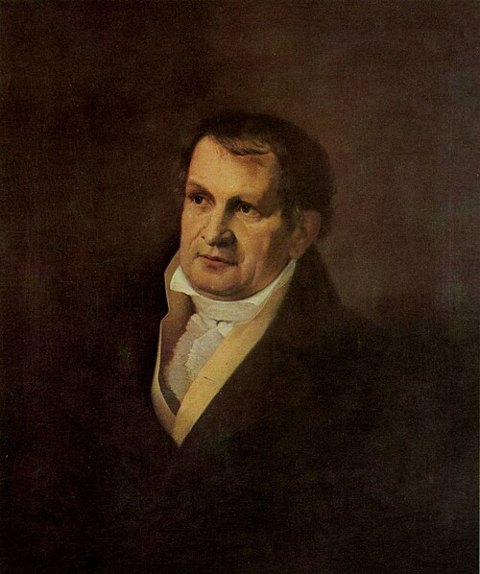
Johann Ludwig Tieck (German: [tiːk]; 31 May 1773 – 28 April 1853) was a German poet, fiction writer, translator, and critic. He was one of the founding fathers of the Romantic movement in the late 18th and early 19th centuries.
Early life
Tieck was born in Berlin, the son of a rope-maker. His siblings were the sculptor Christian Friedrich Tieck and the poet Sophie Tieck. He was educated at the Friedrichswerdersches Gymnasium, where he learned Greek and Latin, as required in most preparatory schools. He also began learning Italian at a very young age, from a grenadier with whom he became acquainted. Through this friendship, Tieck was given a first-hand look at the poor, which could be linked to his work as a Romanticist. He later attended the universities of Halle, Göttingen, and Erlangen. At Göttingen, he studied Shakespeare and Elizabethan drama.
On returning to Berlin in 1794, Tieck attempted to make a living by writing. He contributed a number of short stories (1795–98) to the series Straussfedern, published by the bookseller C. F. Nicolai and originally edited by J. K. A. Musäus. He also wrote Abdallah (1796) and a novel in letters, William Lovell (3 vols, 1795–96).
Adoption of Romanticism
Tieck's transition to Romanticism is seen in the series of plays and stories published under the title Volksmärchen von Peter Lebrecht (3 vols., 1797), a collection containing the fairy tale Der blonde Eckbert, which blends exploration of the paranoiac mind with the realm of the supernatural, and a witty dramatic satire on Berlin literary taste, Puss in Boots (Der gestiefelte Kater). With his school and college friend Wilhelm Heinrich Wackenroder (1773–1798), he planned the novel Franz Sternbalds Wanderungen (vols. i–ii. 1798) which, with Wackenroder's Herzensergiessungen (1796), was the first expression of the Romantic enthusiasm for old German art.